
The Missing Quarter-Million: What Really Happened to Pakistan’s University Enrollment
Abstract
Pakistan’s university enrollment fell for the first time in over a decade, from a peak of 2.2 million in 2020-21 to just under 1.95 million by 2023-24, a contraction of roughly 275,000 students. The conventional explanation blames inflation and a weak job market – only half right. The more traceable cause is a 2019 decision by HEC to abolish the two-year BA/BSc degree, the default low-cost credential at institutions like Allama Iqbal Open University, financed by a $400 million World Bank loan that rewarded speed of rollout over enrollment safeguards. HEC’s claimed recovery is largely illusory: public enrollment has barely moved since 2021-22, while private universities grew every year since 2018-19 and now hold over 21 percent of enrollment. AIOU’s own admissions data, in steep decline since the reform began, offer the clearest trace of its effect. The brief recommends a mandatory enrollment-impact requirement for future reforms of this scale.
I. Introduction
University enrollment figures are usually read as a single number: more graduates, more growth. But headcount and field composition are different things, and together they determine what an education system contributes to the economy. Human capital theory, developed by Schultz and Becker and given testable form in Mincer’s earnings equation, is the standard justification for public investment in higher education,2,3,4 and the logic behind Pakistan’s decade of university expansion. Discipline-level data shows students moving toward ICT and health while drifting from engineering and the natural sciences even as the aggregate stalled, a shift the topline number alone cannot capture. This brief tracks both.
II. The Promise on Paper
HEC was created in 2002 out of the former University Grants Commission to accredit universities, channel public funding, and enforce quality.5 HEC did not present the 2019 degree reform, which abolished the two-year BA/BSc credential, as a labor-market intervention, framing it as a curriculum fix toward more foundational coursework before specialization.6 But restructuring how millions of students move through a degree is also an intervention into enrollment: HEC’s 2020 policy contains no enrollment impact analysis, financed under a $400 million World Bank loan that rewarded speed of rollout, with no enrollment safeguard added until two years in.
III. The Numbers, Laid Out Straight
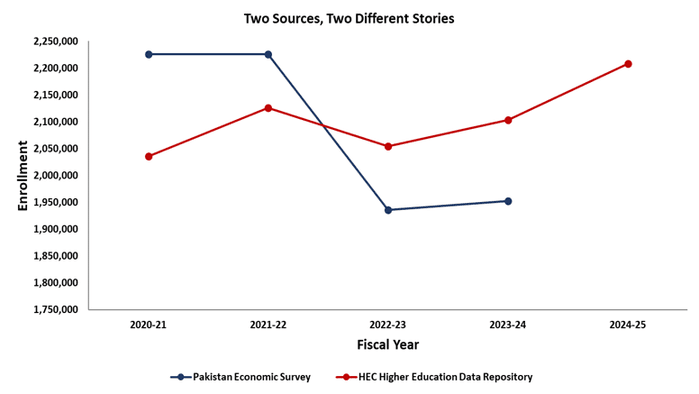
University enrollment is a proxy for households’ revealed confidence in the value of a degree. For a decade after 2010-11, Pakistan’s Economic Survey recorded uninterrupted growth, reaching a stated peak in 2020-21 (Figure 1).7 That growth broke for the first time in 2022-23, a decline of close to 290,000 in under two years, timed closely with the 2019 reform’s rollout. The Survey’s own table complicates this: two entries, 2013-14 and 2021-22, repeat the prior year’s figure exactly. The true 2021-22 figure surfaces only in the Survey’s narrative text, and the recovery that follows is real but incomplete, still about 265,000 short of the 2020-21 peak five years later.8
IV. Two Tables, Two Different Stories
Pakistan’s two principal sources on university enrollment, the Economic Survey and HEC’s Higher Education Data Repository (HEDR), diverge on a basic question: has enrollment recovered past its 2020-21 peak. By the Survey’s figures, the university system remained roughly 270,000 students below that peak as of 2023-24. HEDR’s dashboard shows the opposite trajectory, recording a 2024-25 total that exceeds every year in the Survey’s series.
The difference in institutional scope, often the first explanation to reach for, does not hold up on inspection. HEDR’s coverage of constituent and affiliated colleges alongside universities should, in principle, produce consistently higher totals than the Survey’s narrower “Universities” count. Instead, for 2020-21, HEDR’s total sits nearly 190,000 below the Survey’s, the reverse of what a wider net would predict. A more plausible explanation is that HEDR’s reporting infrastructure, built in 2020, was still being extended to institutions nationally through these years, so part of its apparent later-year growth may reflect fuller institutional reporting rather than additional students. Neither series can be treated as the more reliable of the two on current evidence, and the source of the gap remains an open question the available data cannot settle.
Figure 1: Pakistan Economic Survey enrolment compared with HEC enrolment
Sources: Pakistan Economic Survey; HEC Higher Education Data Repository
V. Public Struggles, Private Grows
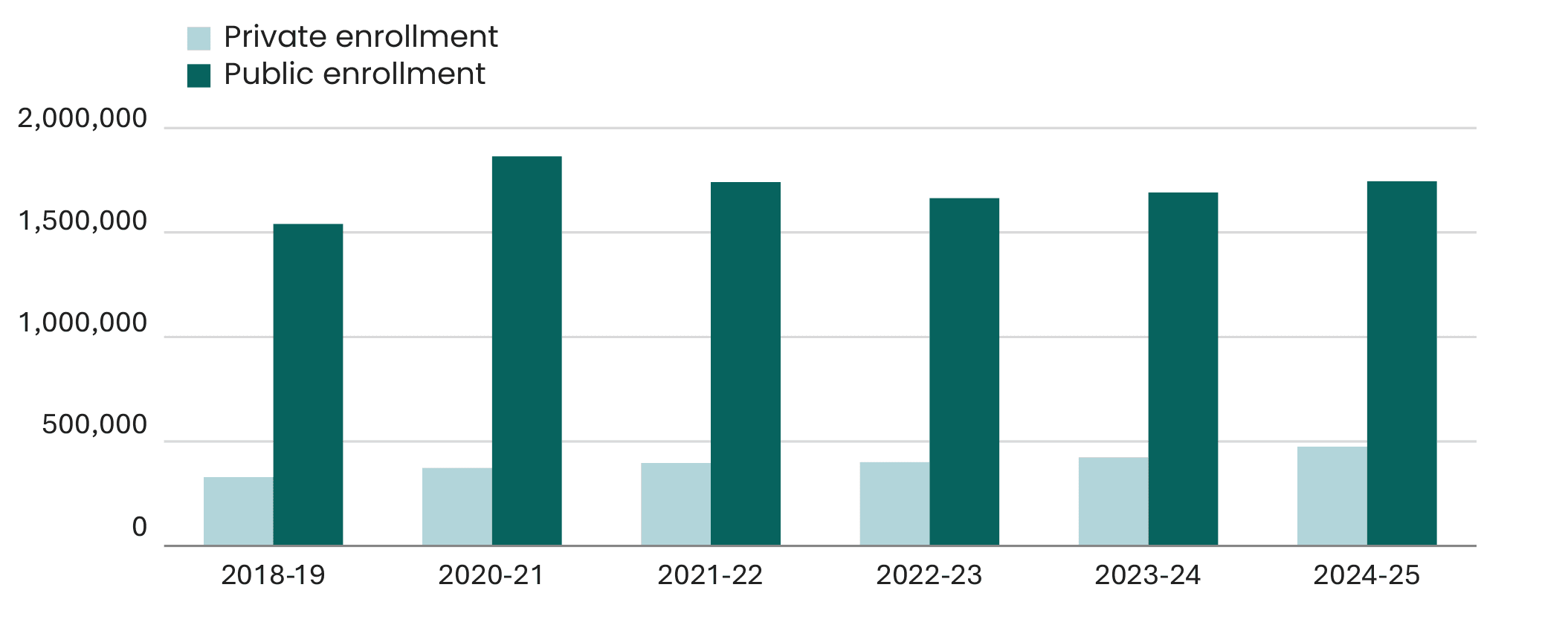
Splitting the record by sector shows two different trends (Table 1). Private university enrollment rose every year in HEDR’s series without exception, including 2022-23, the year the Survey calls a national crisis, and its share climbed from about 17 percent in 2018-19 to over a fifth by 2024-25. Public enrollment did not collapse but stalled, netting only a few thousand additional students since 2021-22, a marked break from the growth it had sustained for a decade before the reform. The most plausible reading is exposure, not differential management: private universities sit largely outside the affiliated-college network and the credential the reform phased out, while public universities and their constituent colleges sat directly in its path. The divide, in other words, runs along the boundary the reform itself drew, not along any difference in how the two sectors were run. Private grew through the crisis; public, sitting exactly where the reform reached, did not.
| Year | Private enrollment | Private share | Public enrollment |
|---|---|---|---|
| 2018-19 | 323,334 | 17.4% | 1,535,370 |
| 2020-21 | 367,287 | 16.5% | 1,858,964 |
| 2021-22 | 390,958 | 18.4% | 1,735,172 |
| 2022-23 | 395,338 | 19.2% | 1,659,164 |
| 2023-24 | 418,034 | 19.9% | 1,685,760 |
| 2024-25 | 468,695 | 21.2% | 1,739,456 |
Figure 2: Public Vs Private Enrolment
Source: Pakistan Economic Survey
VI. Follow the Major
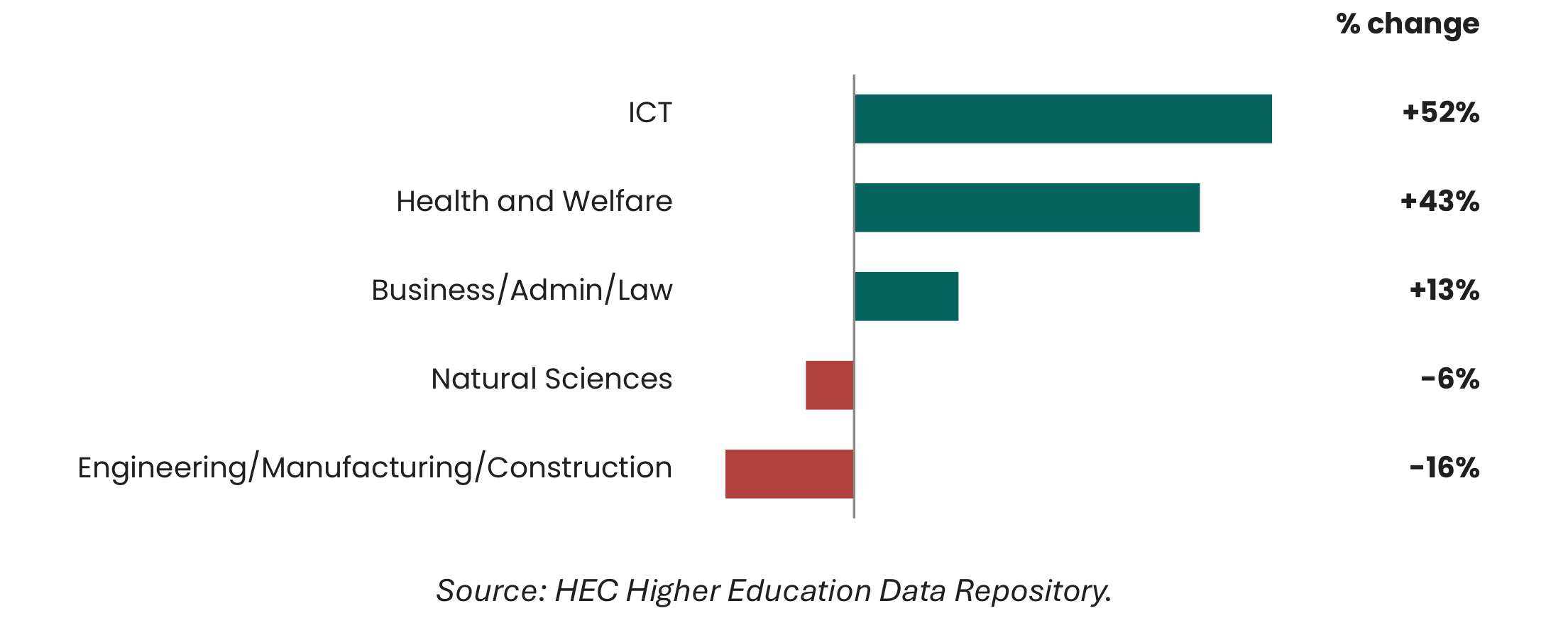
Enrollment by discipline moved unevenly while the aggregate stalled: ICT and health and welfare grew every year without interruption, while engineering and the natural sciences shrank, engineering in one sharp break (Figure 3).9 Business, admin and law grew steadily, a useful baseline for an unaffected field. The decline in engineering and natural sciences is not evenly spread by gender, a detail a pure labor-market-risk story does not explain: in both fields, men are leaving faster than women, not because women’s enrollment is surging. Admissions patterns, capacity constraints, or gender-differentiated family decisions are plausibly doing real work alongside whatever risk signal students are responding to.
Figure 3: Five-year enrollment change by discipline, 2020-21 to 2024-25
VII. Where The Missing Students Went
The decline in national enrollment raises the question of where these students were absorbed. The evidence sides against the two commonly proposed destinations. Technical and vocational training does not: a PIDE brief puts TVET enrollment at under 1 percent of enrollment across all levels.10 Degree colleges do not either, as their enrollment fell over the same period rather than absorbing students stepping down. Study abroad is real but partial. The United Kingdom saw the sharpest jump: study visas issued to Pakistani students rose from 23,075 in 2021-22 to 34,690 in 2022-23, a 50 percent increase in a single year.11 Australia moved the opposite way after an initial surge, granting 19,011 student visas to Pakistanis in 2022-23 before that fell to 7,399 in 2023-24 and just 4,978 in 2024-25, a decline of nearly three-quarters in two years.12 Germany’s Pakistani student population reached roughly 10,000 by 2023-24, smaller in absolute terms than either the UK or Australia’s peak, but a meaningful and growing outflow in its own right.13 Set against this, a PIDE brief puts total outbound mobility north of 100,000 by 2022, and flags that Pakistan’s own BEOE tracking system misses Australia entirely despite its ranking among Australia’s top ten source countries for years.14
Even so, outbound migration explains only roughly a quarter to a third of the domestic decline. The clearest single trace sits inside Allama Iqbal Open University, the largest provider of the credential HEC phased out: AIOU enrolled 1.41 million students in 2019, falling to 991,898 by 2023, a continuous decline of about 420,000.15 AIOU spokesperson Dr Bakht Rawan told Dawn the reform was a main driver, alongside COVID-19 disruption, pushing back on a fee-increase explanation since AIOU’s tuition remains well below other public universities’.
VIII. Conclusion
Pakistan’s enrollment contraction is usually blamed on the economy, but the timeline does not support that. It began in 2019, when HEC phased out the two-year BA/BSc degree and rebuilt the system around a track nobody modeled against enrollment or the labor market, financed by a $400 million World Bank loan that rewarded speed of rollout over safeguards. AIOU’s collapse from 1.4 million to under a million within four years, named by its own spokesperson as reform-driven, is the clearest single trace of that effect. The pattern holds across every cut of the data: private universities grew through the crisis while public ones stalled; engineering and sciences shrank while ICT and health surged; a meaningful share of the missing students left the country rather than the education system; and two government datasets cannot agree whether the crisis has ended. This is a regulatory story with the economy as accomplice, not culprit.
IX. Recommendations
Based on the findings above, the following measures would address the regulatory failures at the root of Pakistan’s enrollment contraction.
- Mandatory ex ante impact assessment. Future degree-architecture reforms of this scale should require an enrollment and labor-market impact assessment before implementation.
- Enrollment safeguards in financing terms. Concessional financing tied to such reforms should build in enrollment safeguards from the outset, not retrofit them years in.
- Reconciled reporting systems. HEC’s Economic Survey and Data Repository should share consistent institutional definitions and de-duplication practices.
- Permanent transition mechanisms. Future credential changes should build in standing transition arrangements so students partway through are not penalised.
- Formal tracking of outbound migration. Migration has grown large enough to warrant tracking as a leading indicator alongside domestic enrollment data.
Notes
- The Author is a student of NUST and wrote this article as part of an internship at Prime Institute.
- Mincer, Jacob. Schooling, Experience, and Earnings. New York: National Bureau of Economic Research, 1974.
- Becker, Gary S. Human Capital: A Theoretical and Empirical Analysis, with Special Reference to Education. Chicago: University of Chicago Press, 1964.
- Schultz, Theodore W. “Investment in Human Capital.” American Economic Review 51, no. 1 (1961): 1–17.
- Higher Education Commission. “About HEC.” Higher Education Commission of Pakistan. Accessed 2026. https://www.hec.gov.pk/english/aboutus/Pages/default.aspx
- Higher Education Commission. Undergraduate Education Policy 2020. Islamabad: Higher Education Commission, 2020. https://www.hec.gov.pk/english/services/faculty/Plagiarism/Documents/UGE-Policy.pdf
- Government of Pakistan, Finance Division. Pakistan Economic Survey 2023-24. Chapter 10, “Education.” 2024. https://finance.gov.pk/survey/chapter_24/10_education.pdf
- Government of Pakistan, Finance Division. Pakistan Economic Survey 2024-25. Chapter 10, “Education.” 2025. https://www.finance.gov.pk/survey/chapter_25/10_Education.pdf
- ibid.,4
- Pakistan Institute of Development Economics. “What’s Your Degree Worth? Return to Education, Employability, and Upskilling Workforce in Pakistan.” PIDE Knowledge Brief No. 101:2023. Center for Social and Behavioral Analysis, 2023. https://pide.org.pk/research/whats-your-degree-worth-return-to-education-employability-and-upskilling-workforce-in-pakistan-2/
- ICEF Monitor, “UK Reports Record Foreign Enrolment for 2022/23,” August 2024, citing UK Higher Education Statistics Agency (HESA) data, https://monitor.icef.com/2024/08/uk-reports-record-foreign-enrolment-for-2022-23/
- thepienews.com, “Pakistani Students Are More Than a Visa Statistic,” 2026, citing Australian Department of Home Affairs data, https://thepienews.com/pakistani-students-are-more-than-a-visa-statistic/; Junaid Ahmed, “Pakistan’s Emigration: Trends and Insights,” PIDE Knowledge Brief 2024:112, Pakistan Institute of Development Economics, February 2024, https://file.pide.org.pk/pdfpideresearch/kb-112-pakistans-emigration-trends-and-insights.pdf
- German Academic Exchange Service (DAAD) and German Centre for Higher Education Research and Science Studies (DZHW), Wissenschaft weltoffen 2025: Facts and Figures on the International Nature of Studying and Research in Germany, compact edition (Bonn: DAAD, 2025), https://www.wissenschaft-weltoffen.de/content/uploads/2025/04/WWO_Kompakt_DT_barrierefrei.pdf
- Ahmed, “Pakistan’s Emigration.”
- Dawn, “AIOU Admissions Plummet During Last Five Years,” January 20, 2024, https://www.dawn.com/news/1807214