
Combating Illicit Trade in Pakistan: A Framework for Tracking Progress on Reforms
Executive Summary
Illicit trade is a structural issue prevalent in Pakistan in three forms: smuggling of goods across borders, locally manufactured products on which taxes have been evaded, and counterfeit goods circulating in place of legitimate products. These illicit practices erode government revenues, create unfair competition for law-abiding businesses, and distort markets in ways that undermine investor confidence and economic growth. The government of Pakistan, while acknowledging the presence of a huge illicit or grey market, introduced a comprehensive set of legislative and enforcement reforms in the Finance Act 2025. The success of these reforms is directly linked to the government’s broader objectives of restoring market competition and closing the revenue leakages that have constrained fiscal stability.
The reforms span a wide range of measures and adopt modern, digitally enabled approaches that have been proven effective in comparable economies. They include a mandatory digital cargo tracking system to monitor goods in real time, technology-based enforcement stations at borders and transit routes, faceless customs assessment to eliminate mismanagement in goods clearance, criminalization of tax fraud and fake invoicing, restrictions on high-value economic transactions for non-filers, and enforcement powers extended to provincial authorities for counterfeit excisable goods. These measures are designed to modernize enforcement, improve compliance, and reduce the space available for illicit trade to operate across the economy.
One year into enactment, it is time to do an initial stock taking of progress. Three reforms can be highlighted: the Faceless Customs Assessment System, vehicle seizures are being conducted under the new provisions, and provincial officers have begun seizing counterfeit excisable goods. Six reforms are in active procurement or early administrative implementation. Four reforms remain at the legislation-only stage, as each requires an additional official notification before its provisions can take effect. Reforms that could be enforced immediately using existing capacity have moved; those that require new digital infrastructure or a change in institutional behaviour have yet to produce measurable output.
This report is designed to inform stakeholders in tracking progress on these reforms in a structured and holistic manner. It assesses each reform against the objective the government has set for it, identifies where implementation is falling short, establishes a baseline for monitoring outcomes and evaluates efforts in curtailing grey market. As implementation progresses, this framework will be used to acknowledge reforms, highlight issues for the attention of policymakers, and assess whether the government’s enforcement effort is achieving its intended objectives.
Introduction
Illicit trade is a structural challenge for Pakistan, prevailing across a wide range of sectors and commodity types. Smuggled petroleum products, non-duty-paid cigarettes, counterfeit pharmaceuticals, non-custom-paid vehicles, under-invoiced consumer goods, and narcotics circulate in the economy. These products prevail due to enabling conditions: porous and difficult-to-monitor borders, a large and deeply entrenched informal economy, fragmented inter-agency enforcement, and price differentials that make illicit goods consistently more attractive to price-sensitive consumers.
PRIME and Transnational Alliance to Combat Illicit Trade (TRACIT) published a joint report1 in 2025 to illustrate the extent of illicit trade by focusing on a few key sectors and received acknowledgement from the government and other stakeholders. The government of Pakistan also realized the emergence of a grey market in which non-compliant products compete openly with legally manufactured and taxed commodities, distorting markets, penalizing compliant businesses, undermining regulatory credibility, and eroding the revenue base that funds public services and macroeconomic stability. Resultantly, the government decided to introduce a comprehensive set of legislative and administrative reforms through the Finance Act 2025.
This report is a sequel to the earlier publication and intended to inform policymakers, government officials, Federal Board of Revenue (FBR), and the business community. The purpose of this brief is to develop a structured mechanism for tracking progress on the reforms to combat illicit trade introduced under the Finance Act 2025. The brief provides an evidence-based basis for identifying where delivery is falling short, gives FBR a consistent reference point for monitoring its own progress, and gives the business community a transparent account of where each reform stands, a year after its introduction, against the objective the government has set for it. As reforms move from legislation toward full operation, this brief establishes the baseline against which their outcomes can be assessed.
Prevalence of Illicit Trade in Pakistan
Pakistan’s low standing on the Illicit Trade Index illustrates the scale of the challenge the government faces. According to the Illicit Trade Index 20252, published by the TRACIT, Pakistan ranks 101 out of 158 countries, placing it among the lower third of nations in terms of resilience to illicit trade. The Index is built around six dimensions: Trade, Customs and Borders; Supply Chain Intermediaries; Sectoral Illicit Trade Indicators; Taxation and Economic Environment; Regulatory Framework and Enforcement; and Criminal Enablers of Illicit Trade (Table 1). Pakistan’s performance varies significantly across the six dimensions. Its highest is in Trade, Customs and Borders (75.4), which reflects relatively stronger border controls and customs management. However, the two lowest-scoring dimensions are Supply Chain Intermediaries (25.9) and Sectoral Illicit Trade Indicators (29.3), revealing serious gaps in how goods are monitored within domestic trade networks and in sector-specific compliance. Scores of 42.7 in Criminal Enablers of Illicit Trade, 46.4 in Regulatory Framework and Enforcement, and 47.3 in Taxation and Economic Environment all fall below the global average, indicating systemic weaknesses in policy implementation and enforcement capacity.
| Dimension | Pakistan Score | Global Average |
|---|---|---|
| Taxation and Economic Environment | 47.3 | Below average |
| Regulatory Framework and Enforcement | 46.4 | Below average |
| Criminal Enablers of Illicit Trade | 42.7 | Below average |
| Trade, Customs and Borders | 75.4 | Above average |
| Supply Chain Intermediaries | 25.9 | Below average |
| Sectoral Illicit Trade Indicators | 29.3 | Below average |
| Composite Score | 44.5 | 49.9 |
The enforcement data from 2025 provides a sectoral picture of where these flows are most concentrated (Figure 1). FBR and Customs officials intensified enforcement measures across multiple sectors, resulting in the confiscation of a wide range of smuggled goods under various operations across the country. The following figure shows the sectoral distribution of illicit goods seized in 2025.
| Category | Value (Rs. bn) |
|---|---|
| Vehicles | 9.8 |
| Diesel | 1.1 |
| Cigarette | 1.8 |
| Precious Metals (Gold & Silver) | 0.5 |
| Cell Phones | 0.2 |
| Narcotics | 60 |
Source: FBR Press Releases3
Major enforcement operations were conducted in sectors including narcotics, non-custom-paid automobiles, smuggled high-speed diesel, and tobacco goods. The estimated value of narcotics alone accounted for Rs.60.43 billion, primarily driven by large crystal methamphetamine consignments. Crackdown on non-custom-paid vehicles remained a focus of the enforcement agencies due to their role in terrorism. Over 1,000 vehicles worth Rs.9.8 billion were seized in multiple operations. While these seizures reveal the effectiveness of enforcement in high-value trafficking, they also show the extent of established illicit commodities operating within the country.
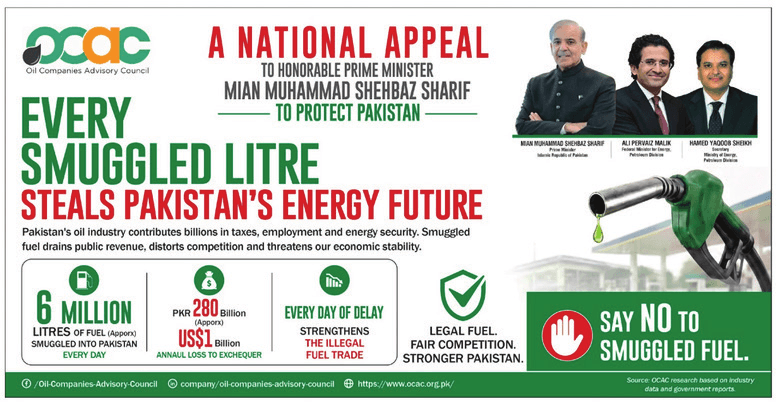
The scale of the challenge is echoed by industry itself. In a public appeal to the Prime Minister, the Oil Companies Advisory Council (OCAC) estimated that approximately 6 million litres of fuel are smuggled into Pakistan every day, resulting in an annual loss to the exchequer of roughly PKR 280 billion (US$1 billion) every year (Figure 2). While petroleum is not among the reforms tracked under the Finance Act 2025 register in this report, the appeal illustrates that the revenue and market-distortion effects documented above extend well beyond the sectors covered by the current reform package, and that industry stakeholders are actively calling for enforcement action of their own.
Description of Government Initiatives
In 2025, the Government of Pakistan undertook a broad set of legislative and administrative measures in the Finance Act 2025 to curb illicit trade, with an emphasis on strengthening enforcement, enhancing monitoring mechanisms, and improving compliance. These measures aim to reduce market distortions, improve revenue collection, and restore competition in the economy.
1. Digital Cargo Tracking System and e-Bilty
The government has introduced a mandatory digital Cargo Tracking System requiring all import, export, transit, and transshipment consignments to be monitored in real time, with each shipment carrying an electronic document, the e-Bilty, across the supply chain.4 The objective is to eliminate the under-declaration, document substitution, and transit abuse that have long enabled illicit trade. FBR signed a design contract with a South Korean firm in March 20265 following an Expression of Interest advertised in September 20256. The system is not yet deployed at any cargo entry or exit point; implementation is projected within 18 months of the design phase completing.
2. Digital Enforcement Stations
The government announced the establishment of the Digital Enforcement Stations, under Section 226 of the Customs Act, 19697, at high-risk smuggling locations along borders and transit routes, with powers to deploy technology-equipped enforcement posts and recruit retired military personnel for staffing. FBR advertised for an ICT Infrastructure and Systems Design Specialist8 in December 2025, invited bids in January 2026 for a three-year Central Control Unit (CCU) contract9 to serve as the central monitoring and coordination facility for DES, point-of-sale systems, digital invoicing, cargo tracking and vehicle management; and issued a uniform-procurement bid10 in April 2026. Five digital stations have been partially established and ten check posts in Balochistan upgraded; the CCU itself is not yet operational11.
3. Centralized Customs Assessment
To eliminate the direct contact between importers and appraisers that had long enabled corruption and inconsistency in customs processing, the Finance Act 202512 gave legal backing to Centralized Assessment Units and Centralized Examination Units, enabling goods declarations to be assessed and examined remotely through AI-assisted digital tools rather than at the point of entry. This provided the statutory foundation for the Faceless Customs Assessment System (FCAS)13, which FBR had already launched in Karachi in December 2024. Within two weeks of launch, the system reduced container dwell time by 39 percent and physical examination cases by 86 percent14. A Centralized Examination Unit was subsequently established at Karachi Port15 and FBR announced expansion to dry ports in Lahore, Peshawar, and Quetta for mid-2025; however, that expansion has not materialized.
4. Customs Command Fund
The government announced the creation of a Customs Command Fund to financially reward enforcement officers and informers for anti-smuggling operations and finance the enforcement operations. The establishment of CCF16 is a policy innovation to address weakness in the enforcement ecosystem. The Fund is financed from the proceeds of auctioned confiscated goods, creating a self-sustaining cycle where effective enforcement generates resources for further enforcement. The Fund has been notified but no disbursements have been publicly recorded.
5. Customs Directorate Restructuring and Risk Management Modernization
The Finance Act 2025 reorganized three Customs directorates: the Directorates of Intelligence and Investigation and Risk Management were merged into a single unit; the Internal Audit directorate is renamed Customs Auction; and a new Directorate of Communications and Public Relations is established. Alongside this restructuring, FBR launched the AI-based Risk Management System (RMS 2.0) at a Prime Minister-chaired review meeting in July 2025,17 designed to automate the identification of high-risk consignments. As of October 2025, RMS 2.0 was in test-run at Karachi Port, where it flagged a consignment of banned Indian-origin textile machinery mis-declared as Chinese equipment. Full deployment across ports has not been confirmed.
6. Presumption Against Smuggled Vehicles
The Finance Act 2025 presumes vehicles with tampered, cut-and-weld, or re-stamped chassis numbers to be smuggled and liable to confiscation, regardless of registration status18. A court stay requires a bank guarantee or pay order of at least 50 percent of the recoverable amount, removing the ability to litigate without financial consequence. This closes a longstanding loophole through which smuggled vehicles were regularized using fraudulent documents or used in terrorism-related activities. Over 119 vehicles have been seized, including operations in Quetta19 and Peshawar20. FBR has also issued guidelines for the disposal of confiscated vehicles21.
7. Courier Misuse Control
To stop the fragmentation of courier consignments to avoid customs duties, the Finance Act 2025 reduced the duty-free threshold for courier shipments from Rs.5,000 to Rs.1,00022. This is reinforced by a withholding tax on digitally ordered goods23 and a requirement for online marketplaces and payment intermediaries to submit quarterly statements to FBR24. Together these measures aim to bring the rapidly growing e-commerce supply chain within the tax net. The threshold and reinforcing measures are in force; no quantified enforcement output has been reported.
8. Port and Cargo Discipline
The Finance Act 2025 imposed binding timelines for clearing goods from ports, 20 days for home consumption, warehousing, or transshipment, and 30 days for declaration filing and cargo removal, with confiscation and auction powers applying even while adjudication or appeal is pending25. These measures directly address the practice of indefinite cargo holding at ports, which has historically provided cover for illicit goods, enabled document substitution, and contributed to congestion that undermined legitimate trade. The timelines are in force; aggregate clearance-time data has not been publicly published.
9. Restriction on Transactions of Ineligible Persons
To compel tax registration and return filing, the Finance Act 2025 aims to bar non-filers and persons whose declared income is inconsistent with their economic activity from completing high-value transactions, including vehicle purchases above Rs.7 million, property transfers for residential and commercial property, securities investments above Rs.50 million, and annual cash withdrawals exceeding Rs.100 million26. Participation in the formal economy is made conditional on being a compliant taxpayer. A Federal Government gazette notification is required before the provisions take effect; none has been confirmed as of June 2026.
10. Criminalization of Tax Fraud
The Finance Act 2025 introduced criminal penalties for tax fraud in the Sales Tax Act 199027, formally defining 11 specific fraudulent acts including fake invoicing and record tampering and providing for up to five years’ imprisonment. Arrests are limited to cases above Rs.50 million and require committee or judicial clearance. The objective is to move beyond financial penalties alone and create a credible criminal deterrent against trade fraud. FBR issued operational guidelines28, but no data on inquiries, arrests, or prosecutions has been made public.
11. Control of Counterfeit Excisable Goods
To address illicit cigarettes, beverages, and other excisable goods circulating at the retail and distribution level, the Finance Act 2025 extended seizure and confiscation powers to provincial officers including Assistant Commissioners and Excise and Taxation Officers29. This decentralizes enforcement beyond federal authorities and closer to where these goods are most actively traded. Over 86,000 illegal cigarette packets have been seized in Punjab30 and at least one tobacco manufacturing unit has been sealed31.
12. Data Sharing for Compliance
To close the gap between declared income and actual financial activity, the Finance Act 2025 directed FBR to share taxpayer data with scheduled banks, which must cross-check it against real transaction records and report material variances back to FBR32. Separately, online marketplaces and payment intermediaries are required to report transaction data to FBR33 34, and FBR is empowered to access ISP and telecom subscriber data for fraud investigations35. The legal framework is in place; no evidence of active data flows or marketplace compliance has been made public.
13. Sales Tax Enforcement Against Unregistered Persons
To compel sales tax registration, the Finance Act 202536 introduced a sequential enforcement mechanism against unregistered persons. Section 14AC of the Sales Tax Act, 1990 empowers the Commissioner to direct banks to bar operation of bank accounts of any person who fails to register for sales tax purposes. Section 14AD empowers the Commissioner to direct the property registration authority to bar the transfer of immovable property of any unregistered person and Section 14AE empowers the Chief Commissioner to seal business premises, seize movable property, or appoint a receiver for management of the taxable activity. Each step requires a public hearing with a chamber of commerce representatives before action is taken, preserving procedural fairness. FBR’s Circular No. 02 of 2025-2637 confirmed the framework. However, a Board gazette notification is required before the provisions can take effect, and none has been issued as of June 2026.
Framework for Tracking Progress on Reforms
This section sets out the framework used to track progress on the reforms introduced under the Finance Act 2025. Table 2 identifies the indicators used to measure progress on each of the 13 reforms — the specific evidence, such as seizure counts, disbursement records, or system uptime, that this report draws on. Table 3 then sets out the four-point scale used to translate that evidence into a single implementation stage for each reform, allowing progress to be tracked consistently and revisited on a recurring basis.
| No. | Reform | Indicators to Measure Progress |
|---|---|---|
| 1 | Digital Cargo Tracking System (CTS) & e-Bilty | Share of import, export, transit and transshipment consignments tracked through CTS; number of e-Bilty documents issued; operational status of the system across cargo entry and exit points. |
| 2 | Digital Enforcement Stations (DES) | Number of DES stations established and staffed; operational status of the Central Control Unit (CCU); number of strategic check posts upgraded. |
| 3 | Centralized Customs Control | Operational status of the centralized assessment center; share of Goods Declarations processed through centralized assessment versus regional units. |
| 4 | Customs Command Fund (CCF) | Value and number of disbursements made to informers and customs officers; public disclosure of fund utilization rules and accounts. |
| 5 | Customs Directorate Restructuring & RMS 2.0 | Staffing and operational status of the restructured directorates; number of ports and checkpoints where RMS 2.0 is live; number of RMS-flagged cases resulting in enforcement action. |
| 6 | Presumption Against Smuggled Vehicles | Number of vehicles seized and confiscated under the presumption clause; number of disposal actions completed under Customs General Order No. 04 of 2026. |
| 7 | Courier Misuse Control | Additional duty and tax collected from courier shipments above the revised Rs.1,000 threshold; number of consignment-fragmentation cases detected. |
| 8 | Port and Cargo Discipline | Average Goods Declaration filing and cargo clearance times; number of confiscation, custody, or auction actions for declarations filed beyond the prescribed timeline. |
| 9 | Restriction on Transactions of Ineligible Persons | Date of Federal Government gazette notification bringing provisions into force; number of persons classified as ineligible; number of transactions blocked and registrations triggered. |
| 10 | Criminalization of Tax Fraud | Number of fraud inquiries initiated, arrests made, and prosecutions or compounding settlements secured under the new offence definitions. |
| 11 | Control of Counterfeit Excisable Goods | Volume and value of counterfeit or unstamped excisable goods seized; number of manufacturing units sealed; share of cigarette brands compliant with tax stamps. |
| 12 | Data Sharing for Compliance | Number of banks and EMIs actively transmitting data to FBR; number of variance reports filed; number of audit triggers generated from algorithmic mismatches. |
| 13 | Sales Tax Enforcement Powers Against Unregistered Persons | Date of Board notification bringing Sections 14AC, 14AD and 14AE into force; number of bank accounts barred, property transfers blocked, and premises sealed for unregistered persons; number of sales tax registrations triggered by these enforcement actions. |
Having identified what is measured for each reform, the following scale is used to assess current implementation status: each reform is assigned a current implementation stage with a categorize from 0 to 3, defined in Table 3 below, reflecting how far it has progressed from legislation to full operation with measurable outcomes.
| Stage | Definition | Typical Evidence |
|---|---|---|
| 0 — Legislation Only | The legal instrument is enacted or notified. No procurement, staffing, or operational activity is publicly recorded. | Gazette notification; SRO text; absence of any tender, contract, or disbursement record. |
| 1 — Administratively Initiated | Procurement, contracting, staffing, or system-design work is underway. The system or unit is not yet functioning at any location. | EOI / tender advertisement; signed contract; staffing advertisement; operational guideline. |
| 2 — Partially Operational | The system or unit is live in at least one location, and enforcement outputs are being recorded, but coverage is below full scale. | Confirmed seizure, sealing, or registration action; count of operational sites. |
| 3 — Fully Operational, Outcomes Tracked | The system or unit operates at full intended scope, and outcome indicators are measured and published on a recurring basis. | Published enforcement statistics showing a compliance trend. |
Reforms are assessed conservatively: a reform is considered Stage 2 or above only where the available documentation cites specific, dated operational evidence such as a seizure, a sealed facility, or a live system with named coverage. Procurement activity or a published guideline, without recorded operational output, places a reform at Stage 1.
Register of Progress on Reforms
Table 4 applies this framework to each of the individual reforms, providing the granular basis from which the category-level status is built and against which future updates will be tracked.
| No. | Reform | Stage | Evidence |
|---|---|---|---|
| 1 | Digital Cargo Tracking System (CTS) & e-Bilty | 1 | EOI advertised September 2025; design contract signed March 2026; implementation projected ~18 months out — not yet operational. |
| 2 | Digital Enforcement Stations (DES) | 1 | ICT specialist and CCU bids issued Dec 2025–Jan 2026; 5 stations established and 10 checkpoints upgraded in Balochistan; CCU not yet live. |
| 3 | Centralized Customs Control | 2 | FCAS live in Karachi since December 2024; clearance times reduced 39%; CEU established at Karachi Port under CGO No. 01 of 2025. |
| 4 | Customs Command Fund (CCF) | 0 | Notified via SRO 908(I)/2025; no public record of a single disbursement. |
| 5 | Customs Directorate Restructuring & RMS 2.0 | 1 | Directorates restructured by law; RMS 2.0 in test-run at Karachi Port only as of October 2025; one enforcement alert generated — full deployment not confirmed. |
| 6 | Presumption Against Smuggled Vehicles | 2 | 119+ vehicles seized (Quetta, Peshawar, Dec 2025); CGO No. 04 of 2026 issued for disposal procedure. |
| 7 | Courier Misuse Control | 1 | Threshold cut to Rs.1,000; reinforcing SRO and ITO provisions in force; no quantified enforcement output publicly available. |
| 8 | Port and Cargo Discipline | 1 | Timelines in force under amended Section 82; aggregate clearance-time data not publicly published; no confirmed confiscation or auction actions reported. |
| 9 | Restriction on Transactions of Ineligible Persons | 0 | Section 114C enacted; provisions come into force on a date to be notified by the Federal Government; no notification confirmed. |
| 10 | Criminalization of Tax Fraud | 1 | Circular No. 02 of 2025-26 issued; no data on inquiries, arrests, or prosecutions. |
| 11 | Control of Counterfeit Excisable Goods | 2 | 86,000+ cigarette packets seized in Punjab; one tobacco manufacturing unit sealed. |
| 12 | Data Sharing for Compliance | 0 | Section 175AA in force; no evidence of bank–FBR data flows. |
| 13 | Sales Tax Enforcement Powers Against Unregistered Persons | 0 | Sections 14AC, 14AD and 14AE enacted; provisions come into force on a date to be notified by the Board; no data on accounts barred, properties blocked, or premises sealed. |
Of the 13 reforms introduced through the Finance Act 2025, none has reached full operation stage after one year of enactment.
- Partially Operational: Three reforms are partially operational. Centralized Customs Assessment, Presumption Against Smuggled Vehicles, and Control of Counterfeit Excisable Goods. These reforms do not require any further legal steps and will start producing results. The FCAS was already running before, the Finance Act gave it a legal basis, and vehicle seizures and cigarette confiscations could begin using existing enforcement capacity.
- Administratively Initiated: Six reforms have been administratively initiated. Digital Cargo Tracking System, Digital Enforcement Stations, Customs Directorate Restructuring & RMS 2.0, Courier Misuse Control, Port and Cargo Discipline, and Criminalization of Tax Fraud. Contracts have been signed, circulars issued, and systems restructured, but no enforcement output has yet been recorded.
- Legislation Only: Four reforms remain at the Legislation Only stage. the Customs Command Fund, Restriction on Transactions of Ineligible Persons, Data Sharing for Compliance, and Sales Tax Enforcement Against Unregistered Persons. In each case, the law has been passed but requires an additional official notification before its provisions can take effect, and none of those notifications has been issued.
The direction of reforms is clear. Reforms that could be enforced immediately with existing capacity have moved while those that depend on new digital infrastructure, such as the Cargo Tracking System and Digital Enforcement Stations, are in procurement and should begin producing measurable output as systems go live over the next year. The reforms that have not started are those requiring a change in institutional behaviour rather than new systems or personnel such as banks actively sharing transaction data with FBR, Commissioners exercising their new powers to freeze accounts and bar property transfers, and the Customs Command Fund making its first disbursement to enforcement officers and informers. This is a good start, but sustained progress against the grey market will depend on translating this early momentum into full operation. Timely operationalization of these remaining reforms should be treated as a priority, with focused attention and resources directed toward institutional and behavioural changes, without which the gains achieved on the enforcement side will remain short lived.
Reform Progress and Its Impact on Pakistan’s Ranking
The Finance Act 2025 reforms are designed to address the very dimensions where Pakistan’s Illicit Trade Index performance is weakest, and their continued implementation is likely to improve the country’s score and overall ranking over time. Reforms such as the Cargo Tracking System, data-sharing under Section 175AA, and enforcement against unregistered persons target Supply Chain Intermediaries, Pakistan’s lowest-scoring dimension, by closing the documentation and monitoring gaps that allow illicit goods to move undetected. The presumption against smuggled vehicles and the extension of seizure powers for counterfeit excisable goods address Sectoral Illicit Trade Indicators, the second-lowest dimension.
The criminalization of tax fraud and the Customs Command Fund are relevant to Criminal Enablers of Illicit Trade, though their impact will only be evident once arrests, prosecutions, and disbursements are recorded and made public. Reforms such as the Faceless Customs Assessment System and Digital Enforcement Stations reinforce Trade, Customs and Borders, the dimension where Pakistan already performs comparatively well. As these reforms move from legislation to full operation and their outcomes are documented and made publicly available, Pakistan’s performance across these dimensions, and its overall ranking in the Index, would improve in line with the progress achieved.
Conclusion
The Finance Act 2025 is a significant step in Pakistan’s effort to eradicate illicit trade. For the first time, the country has a comprehensive legal framework that empowers enforcement across customs, tax compliance, supply chain monitoring, and excisable goods control, drawing on approaches adopted in comparable economies. The main task now is implementation.
Full implementation of these reforms would create tangible benefits across the economy. For businesses that operate within the law, it means a fairer and more competitive environment where smuggled, tax-evaded, and counterfeit goods no longer undercut legitimate enterprise. For the government, it means recovering substantial revenues currently lost to fraud and evasion. For consumers, it means access to safer, regulated products. And for investors, it restores the predictability and rule-of-law assurance that is a precondition for long-term commitment. Eradicating illicit trade is, in this sense, not just an enforcement objective, it is a foundation for a more conducive business environment and sustainable economic growth.
Pakistan’s current ranking of 101st out of 158 countries in the Illicit Trade Index provides a baseline. As the reforms in this brief move from legislation to operation, and as enforcement data becomes publicly available, we anticipate improvements in this ranking, if implementation carries on with same speed. Ultimately new score will indicate whether the measures are having their intended effect. The Index is simply a reference point against which progress, over time, can be measured.
This framework is designed to support the implementation journey. Progress will be measured against the indicators set out in this brief and will highlight the implementation gaps and emerging issues to the FBR, policymakers, and the business community. The objective is to restrict space for grey market and facilitate compliant businesses, honest taxpayers, and domestic and foreign investors the confidence to grow.
PRIME and TRACIT intend to continue tracking these reforms on a recurring basis, updating the Register of Progress as new evidence, notifications, disbursements, and enforcement data become available. This ongoing monitoring is intended to give FBR and policymakers an independent, evidence-based account of where implementation is advancing and where it is stalling, and to give the business community a consistent reference point for assessing the government’s progress. By sustaining this discourse, PRIME and TRACIT aim to support the government in translating the Finance Act 2025 from law into practice, and to ensure that feedback from the sectors most affected by illicit trade continues to inform how these reforms are implemented.
Notes
- PRIME and TRACIT published a joint report “Combating Illicit Trade in Pakistan: A Structural Policy Analysis” in 2025. The report can be accessed at: https://primeinstitute.org/publication/combating-illicit-trade-in-pakistan-a-structural-policy-analysis-april-2025/
- Illicit Trade Index 2025 can be accessed at: https://www.tracit.org/illicit-trade-index-visualization.html#rankingsSection
- Federal Board of Revenue Press Releases, 2025. Available at: https://www.fbr.gov.pk/pr
- Customs Act 1969 (as amended to June 2025). Available at: https://download1.fbr.gov.pk/Docs/20258121285942396CustomsAct1969(June2025)-(12.8.25).pdf
- Dawn, March 2026. Available at: https://www.dawn.com/news/print/1978938
- FBR Expression of Interest — Consulting Services for Feasibility Assessment (CTS), September 2025. Available at: https://download1.fbr.gov.pk/Tenders/2025910992743184REOIConsultingServicesFeasibilityAssessment.pdf
- https://download1.fbr.gov.pk/Docs/20258121285942396CustomsAct1969(June2025)-(12.8.25).pdf
- https://download1.fbr.gov.pk/Tenders/2025121513124219253REOI-ICTInfrastructureandSystemsDesignSpecialist.pdf
- https://download1.fbr.gov.pk/Tenders/20261281913231731CCU.pdf
- https://download1.fbr.gov.pk/Tenders/2026461145153686SPS-RFB.pdf
- Information provided by Customs Officials during an interview.
- Customs Act 1969 (as amended to June 2025), Section 80(6). Available at: https://download1.fbr.gov.pk/Docs/20258121285942396CustomsAct1969(June2025)-(12.8.25).pdf
- FBR Customs General Order No. 06 of 2024 — Faceless Customs Assessment. Available at: https://download1.fbr.gov.pk/Docs/202412101512811717CGO06-2024.pdf
- Express Tribune, December 29, 2024. Available at: https://tribune.com.pk/story/2518781/fbr-brings-reforms-to-clearance-system-without-any-loan
- FBR Customs General Order No. 01 of 2025 — Centralized Examination Unit. Available at: https://download1.fbr.gov.pk/Docs/2025225142012812CGO01-2025.pdf
- SRO 908(I)/2025 — Customs Command Fund. Available at: https://download1.fbr.gov.pk/SROs/20255271555123897SRO908-2025.pdf
- Business Recorder, July 2025. Available at: https://www.brecorder.com/news/40371413
- Customs Act 1969 (as amended to June 2025), Section 187A. Available at: https://download1.fbr.gov.pk/Docs/20258121285942396CustomsAct1969(June2025)-(12.8.25).pdf
- FBR Press Release — Quetta Seizure. Available at: https://urdu.fbr.gov.pk/pr/customs-enforcement-quetta-seizes-28-non-cust/174411
- FBR Press Release — Peshawar Seizure. Available at: https://ipv6.fbr.gov.pk/customs-enforcement-peshawar-seizes-19-nondutypaid-ndp-vehicles-and-smuggled-goods-worth-rs19/174469
- FBR Customs General Order No. 04 of 2026 — Disposal of Confiscated Vehicles. Available at: https://download1.fbr.gov.pk/Docs/2026331153261871CGO04-2026.pdf
- Customs Act 1969 (as amended to June 2025), Section 19C. Available at: https://download1.fbr.gov.pk/Docs/20258121285942396CustomsAct1969(June2025)-(12.8.25).pdf
- SRO 1429(I)/2025 — Withholding Tax on Digitally Ordered Goods. Available at: https://download1.fbr.gov.pk/SROs/2025858833282SRO1429DATED04-08-2025.pdf
- Income Tax Ordinance 2001 (as amended to February 2026). Available at: https://download1.fbr.gov.pk/Docs/2026226162211364IncomeTaxOrdinance2001-Amended-20.02.2026.pdf
- Customs Act 1969 (as amended to June 2025), Section 82. Available at: https://download1.fbr.gov.pk/Docs/20258121285942396CustomsAct1969(June2025)-(12.8.25).pdf
- Income Tax Ordinance 2001, Section 114C (as amended to February 2026). Available at: https://download1.fbr.gov.pk/Docs/2026226162211364IncomeTaxOrdinance2001-Amended-20.02.2026.pdf
- Sales Tax Act 1990 (updated to 2025–26). Available at: https://download1.fbr.gov.pk/Docs/202586148252375SalesTaxActupdatedupto2025-26.pdf
- FBR Circular No. 02 of 2025-26 (Sales Tax and Federal Excise), August 2025. Available at: https://download1.fbr.gov.pk/Docs/202584118361586CircularNO02of2025-26SalesTax&FederalExcise.pdf
- SRO 1279(I)/2025 — Federal Excise (Seizure Powers). Available at: https://download1.fbr.gov.pk/SROs/20257151572624409SRO1279DATED15-07-2025.pdf
- The News International, Punjab Cigarette Seizure. Available at: https://www.thenews.com.pk/print/1384847-punjab-seizes-86-018-illegal-cigarette-packets-on-fbr-s-directive
- PKRevenue, Tobacco Manufacturing Unit Sealed. Available at: https://pkrevenue.com/fbr-seals-souvenir-tobacco-machinery-over-illicit-cigarette-production/
- Income Tax Ordinance 2001, Section 175AA (as amended to February 2026). Available at: https://download1.fbr.gov.pk/Docs/2026226162211364IncomeTaxOrdinance2001-Amended-20.02.2026.pdf
- Income Tax Ordinance 2001, Section 165C (as amended to February 2026). Available at: https://download1.fbr.gov.pk/Docs/2026226162211364IncomeTaxOrdinance2001-Amended-20.02.2026.pdf
- SRO 288(I)/2026 — Marketplace and Payment Intermediary Reporting. Available at: https://download1.fbr.gov.pk/SROs/2026218112270512SRO288dated18.02.2026.pdf
- Sales Tax Act 1990, Section 38B(5) (updated to 2025–26). Available at: https://download1.fbr.gov.pk/Docs/202586148252375SalesTaxActupdatedupto2025-26.pdf
- Sections 14AC, 14AD and 14AE of the Sales Tax Act 1990. Available at: https://download1.fbr.gov.pk/Docs/202586148252375SalesTaxActupdatedupto2025-26.pdf
- FBR Circular No. 02 of 2025-26 (Sales Tax and Federal Excise), August 2025. Available at: https://download1.fbr.gov.pk/Docs/202584118361586CircularNO02of2025-26SalesTax&FederalExcise.pdf