
Economic Fallout of Gulf Energy Disruptions Pakistan’s External Account Vulnerability – Prime Brief
Key Message
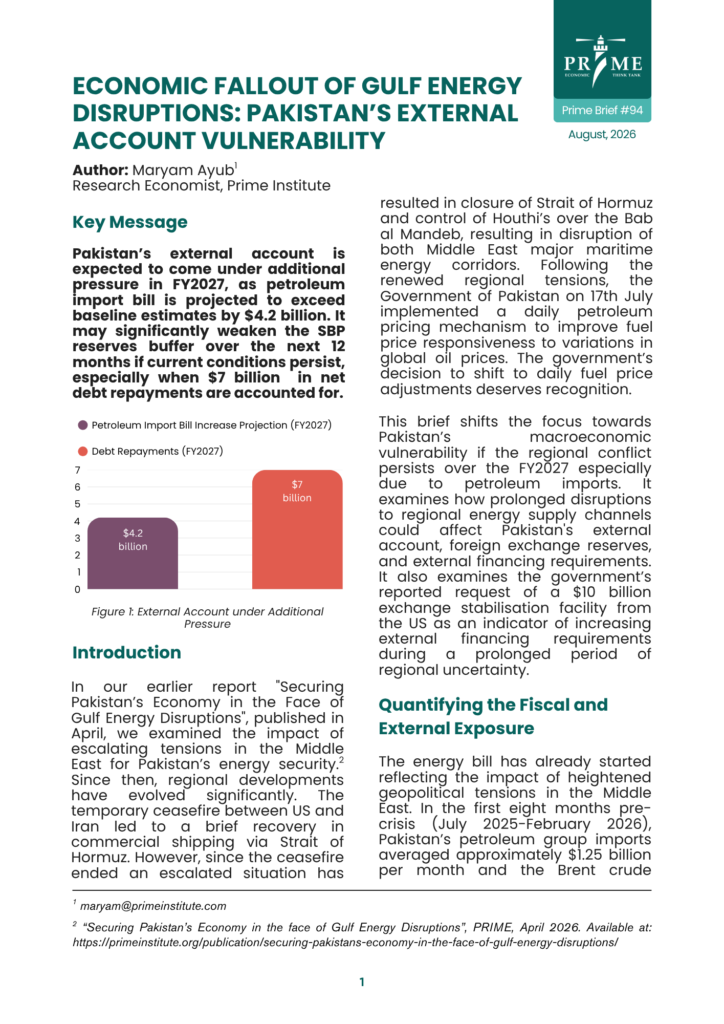
Pakistan’s external account is expected to come under additional pressure in FY2027, as petroleum import bill is projected to exceed baseline estimates by $4.2 billion. It may significantly weaken the SBP reserves buffer over the next 12 months if current conditions persist, especially when $7 billion in net debt repayments are accounted for.
| Item | FY2027 |
|---|---|
| Debt Repayments (FY2027) | $7 billion |
| Petroleum Import Bill Increase Projection (FY2027) | $4.2 billion |
Introduction
In our earlier report “Securing Pakistan’s Economy in the Face of Gulf Energy Disruptions”, published in April, we examined the impact of escalating tensions in the Middle East for Pakistan’s energy security.2 Since then, regional developments have evolved significantly. The temporary ceasefire between US and Iran led to a brief recovery in commercial shipping via Strait of Hormuz. However, since the ceasefire ended an escalated situation has resulted in closure of Strait of Hormuz and control of Houthi’s over the Bab al Mandeb, resulting in disruption of both Middle East major maritime energy corridors. Following the renewed regional tensions, the Government of Pakistan on 17th July implemented a daily petroleum pricing mechanism to improve fuel price responsiveness to variations in global oil prices. The government’s decision to shift to daily fuel price adjustments deserves recognition.
This brief shifts the focus towards Pakistan’s macroeconomic vulnerability if the regional conflict persists over the FY2027 especially due to petroleum imports. It examines how prolonged disruptions to regional energy supply channels could affect Pakistan’s external account, foreign exchange reserves, and external financing requirements. It also examines the government’s reported request of a $10 billion exchange stabilisation facility from the US as an indicator of increasing external financing requirements during a prolonged period of regional uncertainty.
Quantifying the Fiscal and External Exposure
The energy bill has already started reflecting the impact of heightened geopolitical tensions in the Middle East. In the first eight months pre-crisis (July 2025-February 2026), Pakistan’s petroleum group imports averaged approximately $1.25 billion per month and the Brent crude priced at $66-71 per barrel. The economy was absorbing energy costs without exerting too much burden on the external account.
When the crisis started, Brent crude jumped from $70.89/barrel in February to $103.13 in March to $117.29 in April. This represents an 81% increase over the pre-crisis monthly average. Pakistan paid $6.8 billion on petroleum group imports in four post-crisis months (March-June). Using the monthly average petroleum import bill before the regional escalation as the baseline, Pakistan’s petroleum imports during March-June averaged approximately $1.70 billion, exceeding the pre-crisis run rate of $1.25 billion by approximately $454 million per month. LNG imports, however, collapsed, decreasing from $3.47 billion to $2.21 billion in FY26, before falling to zero in April. The country was paying nearly double for oil but receiving no gas at all. If the post-crisis monthly oil imports of approximately $ 1.70 billion persist throughout FY2027, the annual import bill would reach $20.5 billion. The IMF’s projections for FY27 for energy imports stands at $16.31 billion resulting in a potential overshoot of $4.2 billion.3
| Period | Average monthly petroleum imports |
|---|---|
| Pre-crisis (July 2025-February 2026) | $1.25 billion |
| Post-crisis (March 2026-June 2026) | $1.70 billion |
If the current trend persists, Pakistan’s annual petroleum import bill for FY2027 would reach $20.5 billion
The State Bank of Pakistan reserves at the end-June 2026 totalled $18.37 billion, with total liquid reserves of $23.23 billion. Although these reserves levels provide an important external liquidity buffer, they must be accessed alongside the external financing requirements. The external debt obligations of Pakistan for FY27 stand at $21.5 billion. Out of these, $10-11 billion are expected to be rolled over or refinanced, and $6 billion has already been rolled over in July 2026. The economy will still require an estimated $7 billion in net external debt repayments.
The projected increase in energy imports would put additional pressure on the external financing requirement. Under this scenario, the combined effect of $7 billion in net external repayment requirements and an additional $4.2 billion energy imports will lower the effective foreign reserves buffer available to absorb other external shocks. This scenario also assumes that the exchange rate will remain broadly stable and remittance inflows remain persistent, and all expected rollovers are done as planned. Any disruption to these assumptions will increase the pressure on Pakistan’s external account, necessitating additional financing or bilateral assistance.
The government of Pakistan’s reported request to the United States for an additional $10 billion exchange stabilisation facility, is noteworthy in the context of the country’s external financing requirements. However, the US treasury has rarely granted an exchange stabilisation facility in recent years. Recent examples include Argentina receiving a $20 billion exchange stabilisation facility, primarily structured as a currency swap line.4 The proposed facility, with a maturity of up to five years, has been sought in response to the country’s participation in US-Iran’s war diplomacy. Historically, such bilateral stabilisation facilities have been granted only in limited cases. Regardless of its outcome, the request highlights the government’s assessment of elevated external financing risks under a prolonged period of regional instability. While the ongoing $7billion IMF programme, expected Saudi and Chinese deposits rollovers of approximately $9-10 billion and the projected $4.5 billion capital market issuance are expected to support Pakistan’s external financing needs, these reserves may prove to be insufficient if disruptions to regional energy supply routes persist and energy costs remain high over the next 12 months. In such a scenario, extra bilateral finance could strengthen Pakistan’s external liquidity position and provide a buffer against the pressure on foreign exchange reserves.
Policy Recommendations
- Request US sanction waiver for the purchase of petroleum products from Iran: Given the geographical disruptions in traditional fuel import routes, the government may extend efforts to request the US government, a waiver for the purchase of petroleum products from Iran as part of its energy security strategy. Similar exemptions have been granted to other countries including Turkiye, China and most recently India. A regulated petroleum import arrangement from Iran will diversify the fuel supply sources, reduce transportation costs, and enhance energy security during periods of regional disruptions. To capitalise the benefits from formal trade, the government should strengthen border enforcement while also combating fuel smuggling which continues to undermine both the formal market and government revenues.
- Expand the use of local currency settlements for trade with China: Pakistan’s bilateral currency swap agreement with China signed in October 2024 currently valued at 30 billion yuan. Yuan-denominated imports from China increased from 5.6% to 2016, to 19.1% in 2025 and nearly reached 25% in 20265. Pakistan can use this mechanism as an opportunity for expanding the use of renminbi (RMB) in its bilateral trade with China. Utilizing the existing framework, the State Bank of Pakistan may encourage greater use of RMB settlement by facilitating RMB trade finance, supporting commercial banks in offering RMB-denominated payment services, and streamlining settlement procedures for importers. Gradually increasing the share of bilateral trade settled in RMB would reduce immediate demand for US dollars, diversify Pakistan’s external payment arrangements, and strengthen foreign exchange liquidity during periods of heightened external financing pressure.
Figure 3: Effects of expanding RMB settlement Gradually increasing the share of bilateral trade settled in RMB Reduction in immediate demand for US dollars Diversify Pakistan’s external payment arrangements Strengthen foreign exchange liquidity - Protect the remittance channel actively, not passively: Remittances of $41.6 billion in FY26 were the only source of stabilisation of the current account. They completely compensated for the growth in the trade deficit. However, the $649 million current account deficit in June, which was driven in part by a month-on-month fall in remittances, implies that stability can not be assumed. The risk is twofold: Gulf construction and transport slowdowns may reduce employment opportunities for Pakistani workers, and the same shipping disruptions that affect trade also affect the Gulf economies that employ them. Pakistan should negotiate bilateral labour retention agreements with Saudi Arabia, the UAE, and Qatar to avoid massive displacement of Pakistani workers during the downturn. Simultaneously, the SBP should expand the Roshan Digital Account incentive structure and cut the cost of legal remittance transfers to guarantee that the existing flow continues through recorded channels. A 5 percent decline in remittances, roughly $2 billion, under current conditions, will be enough to push the FY27 current account deficit from the IMF’s projected 0.9 percent of GDP toward 1.5 percent or higher.
Figure 4: Twofold Risk of the Gulf Crisis Risk Channel 1 Gulf construction and transport slowdowns 2 Shipping disruptions that affect trade Leading to reduction in employment opportunities abroad for Pakistani workers - Accelerate IT and services exports as a non-maritime foreign exchange source: IT and IT-enabled services exports increased by roughly 20% in FY26. This is the only major export category that is completely independent of marine shipping routes. It expanded despite regulatory challenges such as withholding tax on freelancer income, restrictive foreign exchange retention rules, and delayed processing of export revenues through banking channels. There is a need to simplify foreign exchange retention rules, streamline banking procedures for export receipts, and remove administrative uncertainties affecting freelancers and software exporters. Expanding digital exports would diversify Pakistan’s export base while generating foreign exchange that is insulated from shipping disruptions.
- Scale up the Saudi deferred oil payment facility: Saudi Arabia’s deferred oil payment facility of $1.2 billion has expired in April 2026. Pakistan has requested for a $6.7 billion facility on concessional conditions. Given Pakistan’s post crisis monthly average of $1.7 billion in petroleum imports, a higher deferred payment settlement will reduce the immediate pressures on foreign exchange reserves. Since Saudi Arabia is Pakistan’s largest crude supplier and source of remittances, securing this facility should remain the government’s top external financial priority.
Conclusion
Following the June ceasefire, the Strait of Hormuz opened briefly, and the commercial transit volumes recovered partially. However, after the end of the ceasefire, the Strait has since closed. Renewed US strikes on Iran and Houthi’s control over Bab-al Mandeb have again disrupted both Middle-East’s major maritime corridors simultaneously.
Pakistan’s petroleum group imports totalled $16.86 billion in FY26, exceeding the IMF’s estimates for energy imports of $15.28 billion by $1.58 billion. The rise was concentrated in the March-June period when monthly import bills were 36% higher than the pre-crisis average. LNG imports were zero in April and reduced by 36% as compared to last year, not due to decline in demand but due to supply chain disruptions. If the post-crisis import trajectory continues throughout the FY27, the annual petroleum bill might exceed the IMF’s $16.31 billion by almost $4.2 billion. The SBP reserves of $18.4 billion at the end of June must cover net external debt repayments of almost $7 billion, as well as absorb an energy import bill that is far higher than expected.
The government’s request for a $10 billion exchange stabilisation facility from the US Treasury, reflects the size of the expected financial need. The UAE’s demand for early repayment of $3.45 billion in April, as well as the subsequent emergency Saudi deposit, have already illustrated how swiftly bilateral agreements may change under geopolitical pressure. The external account is expected to remain under pressure over the next 12 months. Under these circumstances, Pakistan must prioritise maintaining external liquidity while reducing immediate pressure on liquid foreign exchange reserves. Expanding local currency settlement with China, diversifying fuel imports by purchasing petroleum products from Iran, protecting existing remittance inflows, accelerating IT and IT services exports, and securing a larger deferred oil payment facility from Saudi Arabia can help the country’s external financing position and resilience to long-term regional disruptions.
Notes
- maryam@primeinstitute.org
- “Securing Pakistan’s Economy in the face of Gulf Energy Disruptions”, PRIME, April 2026. Available at: https://primeinstitute.org/publication/securing-pakistans-economy-in-the-face-of-gulf-energy-disruptions/
- “Table 3a. Pakistan: Balance of Payments, 2021/22–2030/31”, Pakistan third review under the extended arrangement, May 2026. Available at: https://www.imf.org/-/media/files/publications/cr/2026/english/1pakea2026001.pdf
- “U.S. Financial Support to Argentina”, Congress.Gov. Available at: https://www.congress.gov/crs-product/R48780
- “China, Pakistan move away from USD: 25% of trade already in Yuan”, Fresh News English International, 25 May 2026. Available at: https://en.freshnewsasia.com/index.php/en/internationalnews/70017-2026-05-25-04-09-02.html