
Regulatory Reforms in Pakistan: A Comparative Review of Diagnostic Tools
Abstract
Businesses in Pakistan operate within a regulatory system replete with licenses, approvals and permissions, where the government of Pakistan acts as an administrator rather than a facilitator, and compliant firms face costs and barriers that noncompliant firms escape. The government has acknowledged this problem and commenced multiple reform initiatives to address it. This brief compares the methodologies available to reformers for diagnosing regulatory burden and designing reforms; it does not offer any analysis on the economic implications or efficacy of these reforms. It reviews four methodologies: the World Bank’s Business Ready (B-Ready) Index, the PIDE Sludge Series, the Regulatory Guillotine, and the Standard Cost Model. The review indicates that each answers a different question and suits a different stage of the reform cycle, but none captures discretionary enforcement on its own, and that the tools are best used together, in sequence, rather than as competing choices.1
1. What is Regulation and Why Does It Matter?
At its core, regulation is the framework of rules, laws, and administrative procedures created by the state to guide the behaviour of businesses and individuals. It is the fundamental mechanism through which governments operationalise public policy objectives, from ensuring product safety and protecting the environment to maintaining financial stability and fair competition.
Regulation is essential for a well-functioning market economy. It establishes the rules of the game, creating the predictability and trust necessary for investment and commerce. Good regulation:
- Corrects market failures by addressing issues like pollution, monopolies, or information asymmetries that the market alone cannot resolve.
- Protects public goods and citizens: Ensuring safety standards for food, drugs, and workplaces, and safeguarding consumer rights.
- Creates a level playing field: Preventing unfair practices and ensuring that all firms, whether large or small, compete on a consistent basis.
However, poorly designed and/or inflexible implementation can make regulation a burden. It can stifle innovation, increase costs, create barriers to entry, disproportionately affect small businesses, and create unnecessary sludge and friction. The challenge for governments is to find the right balance: achieving necessary policy goals with the least possible cost and friction for the economy and society. This is the central objective of any regulatory reform.2
Improving regulatory implementation is a global challenge. In a 2025 OECD symposium, Simplifying for Success, business leaders in 90 percent of surveyed countries and government leaders in 72 percent consider the level of regulation and bureaucracy in their countries too burdensome.3 91 percent reported that, in the last three years, their countries had launched measures to simplify regulations and reduce regulatory burden.4
Overall, the OECD observes that a growing volume of regulations, combined with rapid technological change, has led governments to pile new rules upon existing rules, resulting in increasingly complex regulations and rules for the public and private sectors alike.5
2. Introduction
Pakistan’s private sector operates in an environment where firms must secure the approval of multiple, overlapping federal, provincial, and municipal bodies and regulatory agencies before they can register, build, connect to utilities, operate, or trade. Documented and compliant firms bear the burden of these procedures, while informal competitors, who evade the same rules, encounter less scrutiny. Reformers therefore need a consistent way to diagnose where this burden is concentrated and to prioritise action.
This brief compares four methodologies developed for that purpose, i.e., the World Bank’s Business Ready (B-Ready) Index, the PIDE Sludge Series, the Regulatory Guillotine (RG), and the Standard Cost Model (SCM) to evaluate the use cases and feasibility of these tools for Pakistan.
Regulatory burden in Pakistan results less from the sheer number of laws and more from the friction businesses face in day-to-day interactions with the state. When regulators only see their role as controlling and vetting each transaction, they create delays and uncertainty regardless of how well-designed the rules may be. By contrast, when regulators focus on developing and enabling markets and monitoring outcomes, they create conditions in which firms focus on and compete on efficiency and innovation rather than on their ability to navigate bureaucracy.
For reforms to be effective, two shifts are required. First, the state must reposition itself from an administrator to a facilitator. Second, rules must be applied consistently and predictably to both formal and informal operators.
| Administrator Model | Facilitator Model |
|---|---|
| Pre-approve every transaction | Set clear rules, monitor outcomes |
| Multiple agencies, sequential sign-offs | Single window, risk-based checks |
| Discretionary, officer-dependent decisions | Rule-bound, deemed-approval on delay |
| Rules enforced only on formal firms | Consistent enforcement, formal + informal |
Outcome: firms compete on efficiency and quality, not on their ability to navigate approvals.
How to diagnose issues, select tools, and devise reforms are the crucial questions that determine the outcome of reforms. This brief is organised around that question. Section 3 presents the current state of regulatory reforms in Pakistan. Section 4 introduces four available methodologies, describes what these individual tools leave unmeasured and how they fit together. Sections 5 and 6 set out how reformers can sequence these tools in practice.
3. The Regulatory Reform Landscape in Pakistan
There have been many initiatives by the Government of Pakistan to reduce regulatory burden in the last decade. In the Ease of Doing Business review in 2019, Pakistan was recognised by the World Bank as one of South Asia’s top reformers, improving rank from 147th to 108th.6 Gains were prominent in business entry, however, the more pressing issues i.e., tax distortions, regulatory complexity, discretionary inspections, and refund delays remain unaddressed. Pakistan’s improvement in Ease of Doing Business rankings reflected procedural changes rather than improvements in how the system worked in practice. This is exactly the gap that the World Bank’s newer B-Ready framework is designed to evaluate and fill, by looking not only at rules on paper but also at public service delivery and the actual experience of firms.
The government’s regulatory reforms initiative is more institutionally ambitious. The Pakistan Regulatory Modernisation Initiative (PRMI), launched by the Board of Investment in 2019, aimed to identify and eliminate redundant regulations, NOCs, and inspection requirements across federal ministries. Under this initiative, 40 reforms were successfully done.7 PRMI remains active as of 2026 and evolved with the institutional setup of the BOI, the Cabinet Committee on Regulatory Reforms (CCoRR), and the Asaan Karobar platform. The Asaan Karobar Act, 2025, enacted on 25 November 2025, gave this initiative statutory backing.
The Revenue Mobilisation, Investment and Trade (REMIT), a technical assistance programme funded by the UK’s Foreign, Commonwealth & Development Office (FCDO), is another key initiative to support Pakistan in implementing strategic reforms to improve economic development, trade, investment and revenue mobilisation. Under the REMIT programme, the CCoRR has endorsed 558 reforms8, but only 79 have been implemented.
| Reforms endorsed by CCoRR under REMIT | Reforms implemented | Implementation rate to date |
|---|---|---|
| 558 | 79 | 14% |
Source: Cabinet Committee on Regulatory Reforms (CCoRR), reform tracking under the REMIT-supported programme.
The PRMI “Aasan Karobar” platform tracks reform actions by department and sector across multiple agencies – such as SECP, DRAP, IPO, PSQCA, CDA, among others – effectively serving as a live, cross-government reform pipeline.
In parallel, the Asaan Karobar Act (2025) proposes an integrated institutional-and-digital architecture built around three connected components: (i) an Asaan Karobar Technical Unit (AKTU) to review and improve regulations, (ii) a Pakistan Regulatory Registry to develop a comprehensive inventory of regulations, and (iii) a Pakistan Business Portal to provide a single online window for applications, licensing, and payments.
Reform gains to date have been uneven and, in some cases, temporary. In many areas, changes on paper have not translated into noticeable improvements in day-to-day compliance or service delivery. The government explains this implementation gap in terms of inter-ministerial co-ordination delays, uneven digital capacity, and limited interoperability across systems.
Whether a reform ultimately delivers results depends on three linked conditions: credible diagnosis, political endorsement, and execution capability. If the diagnostic approach does not accurately surface the real bottlenecks, especially process frictions and discretion points, it can generate reforms that are easy to approve but hard to implement. In that sense, the methodology used to identify and design reforms is as decisive for outcomes as the implementation effort that follows.
4. Review of Regulatory Reform Methodologies
Four methodologies are covered in this brief because they are either already reflected in Pakistan’s reform architecture or offer lessons that are readily transferable.
First, the World Bank’s B-Ready Index provides a global benchmark of how countries perform across the business lifecycle, assessing the quality of regulatory frameworks, public service delivery, and operational efficiency in a way that enables cross-country comparison.
Second, the Sludge Series developed by the Pakistan Institute of Development Economics (PIDE) is a Pakistan-focused, transaction-level diagnostic that measures the time, financial cost, and opportunity cost embedded in specific administrative processes, and estimates the benefits of simplifying them.
Third, the Regulatory Guillotine is an internationally used implementation approach, applied in multiple countries, designed to rapidly inventory an existing regulatory stock and eliminate, consolidate, or simplify requirements at scale.
Fourth, the Standard Cost Model (SCM) is a European-origin methodology that identifies the “information obligations” imposed by regulation and assigns costs to them, most commonly to measure and reduce administrative burdens created by new or existing rules.
These tools (Table 1: Methodologies at a Glance) support different decisions at different stages of the reform cycle. B-Ready functions primarily as a comparative scorecard, helping governments understand their performance relative to peers, also drawing attention to service delivery bottlenecks. The Sludge Series and SCM are primarily measurement instruments: they quantify the size of the problem and pinpoint where it is concentrated, either at the level of a single transaction (Sludge) or within specific regulatory requirements (SCM). The Guillotine is primarily an implementation mechanism, enabling governments to act quickly on diagnostic findings by systematically reviewing and streamlining large volumes of existing regulation.
| Methodology | What it Measures | Primary Use | Main Shortcoming |
|---|---|---|---|
| PIDE Sludge Series | Time, monetary, and opportunity cost of specific transactions | Building an agency-specific reform and prioritisation agenda | Covers only a sample of processes |
| Regulatory Guillotine | The entire stock of existing regulations | Rapid, economy-wide elimination | Depends on sustained political backing |
| World Bank B-Ready Index | Regulatory framework, public services, and operational efficiency | Cross-country comparison and benchmarking | Standardised indicators miss localised and discretionary practice |
| Standard Cost Model | Administrative burden of specific information obligations | Setting quantified reduction targets | Captures paperwork cost only, not delay or compliance costs |
4.1 World Bank B-Ready Index
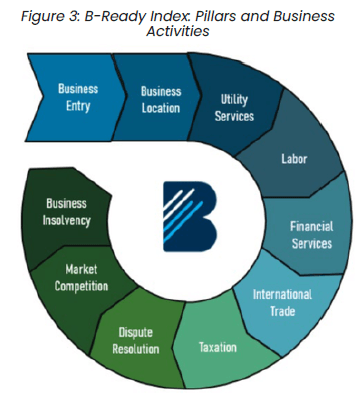
The Business Ready (B-Ready) Index,9 which succeeds the World Bank’s Doing Business rankings, is a benchmarking exercise that quantifies how supportive a country’s business environment is for private sector development. It assesses both the rules and services that shape firms’ interactions with the state and the efficiency with which those rules and services work in practice. The framework is organised around three pillars: (i) the quality of the regulatory framework, (ii) the availability and digitisation of supporting public services, and (iii) the operational efficiency businesses actually experience.
B-Ready applies these pillars across ten stages of the business lifecycle, covering areas such as entry and location, access to utilities, labour, trade, taxation, dispute resolution, and insolvency. Scoring is constructed through a bottom-up aggregation process. For each of the ten topics, individual indicators are scored and then averaged across the three pillars, drawing on two main inputs: expert questionnaires and the World Bank Enterprise Surveys. Topic scores are then aggregated into pillar-level scores and an overall composite index for each economy, enabling comparisons both across countries and across specific lifecycle topics.
This design is intended to capture the gap between law on the books and law in action by combining information on formal requirements with evidence on how processes function for firms. At the same time, cross-country comparability across roughly 180 economies requires standardised metrics, which limits what B-Ready can observe. It cannot reliably detect highly localised or discretionary enforcement issues, such as a single document requirement that routinely delays licensing in one sector, or differences in inspection practices across provinces, in the way a transaction-level tool like the Sludge Series can.
B-Ready data collection also tends to reflect the experience of formally registered firms in major cities, which can understate the burden faced by smaller firms and informal operators. Finally, results may lag recent reforms or reflect reforms that exist on paper but have not yet changed frontline practice, a risk that is particularly relevant in contexts where implementation capacity and interoperability constraints continue to shape outcomes.
4.2 The PIDE Sludge Series
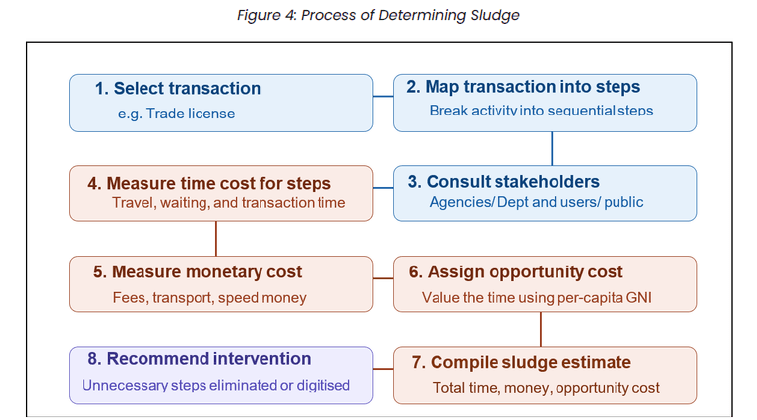
The Sludge Series adapts the idea of “sludge” from Cass Sunstein’s behavioural economics work10 to describe the unnecessary time, financial costs, and psychological friction people and firms face in routine transactions with the state.11 It uses a deliberately granular approach. Researchers take a single transaction, such as obtaining a trade license or opening a restaurant, break it into discrete steps, and then quantify the burden at each step in three ways: time spent, direct monetary cost, and opportunity cost. Opportunity cost is proxied using per-capita GNI, so the total burden can be expressed in a comparable way across transactions (illustrated in Figure 4: Process of Determining Sludge).
Once a baseline is mapped, the Sludge Series estimates how much burden could be reduced under three stylised interventions: digitisation, digitisation plus partial removal of unnecessary documents and visits, and digitisation plus full removal of unnecessary documents and visits. It applies a difference-in-differences framework12 to simulate these scenarios and estimate the reduction each intervention could deliver.13
This produces evidence that is immediately actionable for the agency responsible for the process because it pinpoints the specific drivers of burden, for example, a particular document requirement, an extra office visit, or a discretionary signature. The main constraint is coverage. Because the method is transaction-specific and resource-intensive, it can only be applied to a sample of processes and cannot, by itself, map the full stock of regulations across federal, provincial, and local governments. It is also primarily a measurement and targeting tool rather than an implementation mechanism. It can quantify the gains from reform, but it does not itself deliver the legal repeals, systems integration, or workflow redesign needed to realise those gains.
There are also simplifications in how costs are valued. Using per-capita GNI to monetise time creates a consistent proxy, but the true value of time differs widely across users, such as between a large exporter and a subsistence farmer. For these reasons, the Sludge Series is best treated as a prioritisation and advocacy instrument, and it is most powerful when paired with a mechanism, such as a regulatory guillotine, strong delivery unit, or digitisation program, that can act on its findings at scale.
4.3 The Regulatory Guillotine
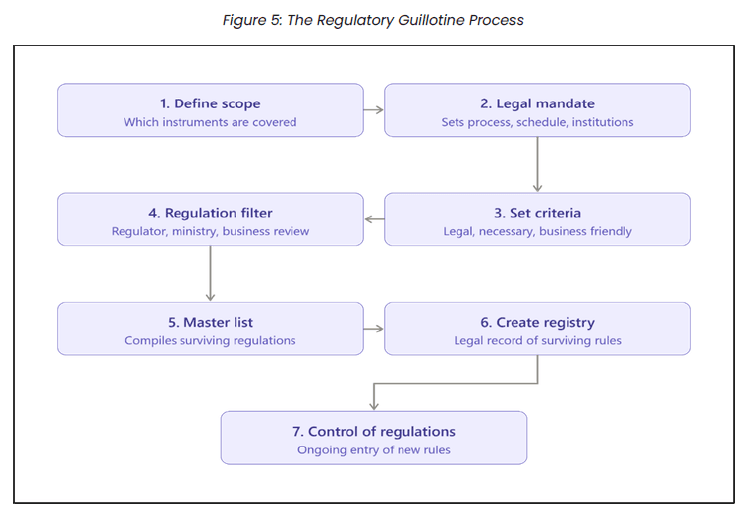
The Regulatory Guillotine, developed by Jacobs, Cordova & Associates (JCA), is a rapid method for reviewing and clearing large stocks of existing regulation using a time-bound, top-down process rather than a slow, rule-by-rule approach (Figure 5: The Regulatory Guillotine Process). It has been applied in several transition and developing economies, including Croatia, Vietnam, Kenya, Moldova, and Ukraine. Reported results across these cases include the elimination or simplification of more than 25,000 regulations and estimated annual compliance cost reductions of around USD 8 billion.14
The Regulatory Guillotine reverses the usual burden of proof: agencies must justify keeping a rule, not reformers removing it.
The process begins by defining the scope of instruments to be reviewed and establishing a legal mandate that fixes the timetable and assigns clear institutional responsibilities. This mandate is critical because it reverses the usual burden of proof: instead of reformers having to justify why a rule should be removed, agencies must justify why a rule should be retained. Regulations are then screened against a small set of straightforward tests, typically whether the requirement is legal, necessary, and business-friendly. Reviews proceed through sequential “filters” involving the issuing regulator, an independent central unit, and business or stakeholder consultation. Rules that pass all filters are consolidated into a single master list; requirements that are not on the list are automatically repealed once the deadline expires.
The master list then becomes an electronic regulatory registry, ideally designed with “positive security,” meaning that only what is included in the registry can be enforced against firms. To prevent burdens from re-accumulating, the system is sustained through ongoing controls that require any new or amended regulation to be entered into the registry within a short, fixed window.
The limitations of the guillotine approach are also well documented. It typically requires sustained high-level political backing to overcome resistance from agencies whose staffing, budgets, or informal revenue streams may depend on maintaining complex requirements. If political sponsorship weakens, reviews can stall and registries may remain incomplete. Outcomes also depend on the rigor of the screening criteria. If reviews become procedural and agencies simply re-register most requirements, the reform may produce a cleaner registry without meaningful reductions in burden. Evaluations of exercises in Moldova, Kenya, and Ukraine found that while some economically significant regulations were removed, capacity constraints and institutional resistance limited the depth and extent of simplification achieved.15
4.4 The Standard Cost Model
The Standard Cost Model (SCM) was developed in the Netherlands in the early 2000s and later adopted by several European governments and institutions, including Denmark, Norway, Sweden, the United Kingdom, Italy, and the European Commission. It has since become one of the most widely used international methods for quantifying administrative regulatory burdens. Its main advantage is that it converts burden into a single monetised figure, which makes it easier to set credible reduction targets and track progress over time.
The SCM is particularly useful ex ante, as part of a formal impact assessment, because it can estimate the administrative cost of a proposed regulation before it is introduced. Used consistently, it helps prevent new burdens from being added even as governments remove older ones. In that sense, it provides a form of ongoing quality control that a one-off stock review, such as a regulatory guillotine, cannot deliver on its own.
Methodologically, the SCM starts by identifying the regulation’s legally required “information obligations,” such as reporting, recordkeeping, notifications, applications, or filings. Each obligation is then broken into the concrete tasks a normally efficient business must perform to comply (see Figure 6: The Standard Cost Model). For each task, the SCM calculates:
- A price, typically an internal or external hourly rate multiplied by the time required; and
- A quantity, typically the number of affected businesses multiplied by how often the task must be done each year.
The product of these yields the annual cost of that obligation. These task estimates are then validated through interviews with businesses to ensure they are realistic and representative. Finally, costs are aggregated across obligations and then across regulations, ministries, or sectors to produce a national baseline, which can be used to guide simplification plans and monitor reductions over time.
| Step | Action | Detail |
|---|---|---|
| 1 | Map information obligations | Identify duties under regulation |
| 2 | Break down activities | List required compliance tasks |
| 3 | Calculate price (P) | Tariff × time taken |
| 4 | Calculate quantity (Q) | Businesses × annual frequency |
| 5 | Compute activity cost | Cost = P × Q per obligation |
| 6 | Verify with businesses | Check representativeness, adjust |
| 7 | Aggregate and report burden | Sum totals, set reduction targets |
The SCM’s limitations are important to state clearly. It measures administrative and information-related costs only. It does not capture substantive compliance costs (such as investment in equipment), the opportunity cost of delays, or the psychological and uncertainty costs that the Sludge Series attempts to quantify. As a result, a regulation can score well under the SCM while still creating major friction through slow approvals or discretionary enforcement. In addition, the SCM depends on reliable wage data, credible estimates of affected firm populations, and cross-ministry standardisation of assumptions. Even in well-resourced European administrations, sustaining these parameters consistently has proven challenging.16 Applied on its own, the SCM is best understood as a tool for controlling the flow of new administrative burdens, not as a complete explanation of why doing business can remain slow or unpredictable.
4.5 Limitations of These Methodologies
Two limitations are prevalent and cut across all four methodologies.
First, none of the tools directly measures discretionary enforcement, meaning the gap between what a rule requires on paper and how it is applied in practice by frontline officials. Pakistan’s stakeholder interviews and enterprise surveys repeatedly point to this gap as a major driver of unpredictability for formal firms, yet it sits largely outside the core focus of benchmarking, transaction costing, stock review, or burden pricing.17 A requirement can be accurately costed, re-registered, and even score well in international comparisons, while still being applied inconsistently at the point of service. Closing this gap typically requires complementary measures that sit alongside these methodologies, such as published procedures, binding timelines, and deemed approval where deadlines are missed.
Second, the four methods serve different points in the reform cycle and none can substitute for sustained political backing and implementation capacity. Each tool is strong at a specific function, diagnosis, prioritisation, mass implementation, or ongoing quality control, but reforms still fail when institutional change does not follow. Pakistan’s experience illustrates this clearly, with reported completion rates below 20 percent in PRMI and REMIT.18 The constraint was not the choice of methodology, but the ability to execute, coordinate across institutions, and sustain change over time. Reformers should therefore match the tool to the reform stage and, critically, build explicit links between diagnosis and delivery so that identified reforms do not remain pending or unimplemented.
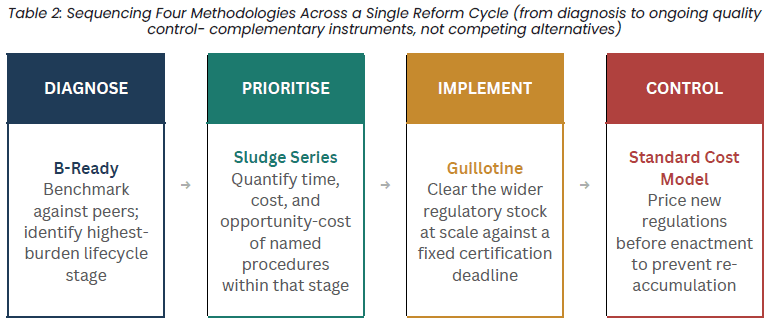
For this reason, this policy brief maps the four methodologies onto a single reform cycle rather than treating them as competing strategies (Table 2). B-Ready fits the diagnostic stage by showing where Pakistan’s relative performance is weakest across the business lifecycle. The Sludge Series supports prioritisation by translating broad findings into transaction-level, agency-specific evidence of where time and cost are concentrated. The Regulatory Guillotine, already reflected in the Asaan Karobar Act, is suited to implementation at scale by clearing or simplifying large volumes of existing rules. The Standard Cost Model supports ongoing control by pricing administrative burdens ex ante, helping ensure that burdens removed through stock reform are not quietly reintroduced through new regulations. Used in sequence, the tools cover the full cycle from diagnosis to safeguards, rather than trying to answer the same question in parallel.
| Stage | Tool | What it does at this stage |
|---|---|---|
| Diagnose | B-Ready | Benchmark against peers; identify highest-burden lifecycle stage |
| Prioritise | Sludge Series | Quantify time, cost, and opportunity-cost of named procedures within that stage |
| Implement | Guillotine | Clear the wider regulatory stock at scale against a fixed certification deadline |
| Control | Standard Cost Model | Price new regulations before enactment to prevent re-accumulation |
5. Strengthening Regulatory Reform through Appropriate Governance and Delivery Mechanisms
5.1 From Simplification to Outcomes
Reducing regulatory burden is not simply a technical exercise in rewriting rules. It is a governance challenge, and success should be judged by whether reforms produce measurable improvements for firms and the wider economy. Even when regulations are simplified on paper, businesses may still face delays, repeated visits, inconsistent interpretations, and informal requirements that erode or cancel the intended gains.
A credible reform framework therefore needs a clear chain from diagnosis to implementation, and from implementation to verified changes in the frontline experience of doing business. The four tools reviewed in this brief cover distinct functions in that chain: diagnosis, prioritisation, rapid implementation, and cost-based control. They deliver the most value when used together as a single reform cycle, reinforced by delivery mechanisms, accountability, and data systems that ensure reforms are not just announced or recorded, but executed and demonstrably effective in practice.
5.2 Three System Improvements that Make the Value Chain Work
To translate diagnostic findings into real, measurable reductions in regulatory burden, the reform cycle should be strengthened with three reinforcing practices:
- Institutionalise structured ex ante assessment for significant reforms. Before major regulatory changes are approved, proposals should compare realistic options, anticipate likely impacts, and set out a practical plan for implementation. This discipline helps ensure reforms are selected for expected net benefits rather than for political expedience, convenience, or optics, and it provides a clear benchmark for accountability if results fall short.
- Make stakeholder engagement continuous, not episodic. Engagement should begin early to validate bottlenecks, continue during design to stress-test options, and follow implementation to confirm whether outcomes improved. Inputs should be documented, and decision documents should show how feedback influenced choices. When firms, regulators, and civil society can see that consultation affected the final design, acceptance rises and compliance improves.
- Require monitoring, evaluation, and feedback after rollout. Reforms should not be treated as complete once approved or notified. Implementation should be tracked, performance measured against predefined targets, and course corrections made when outcomes lag. A continuous cycle of evaluation reduces the risk of “paper reforms” by ensuring that reforms are implemented, outcomes are verified, and problems are addressed promptly.
5.3 Making Discretionary Enforcement Visible and Manageable
Discretionary enforcement, meaning the informal and inconsistent application of rules, is often the largest source of uncertainty for firms. No single diagnostic tool can fully measure it on its own, but a practical “discretion control” package can make frontline implementation visible and manageable by turning firm–official interactions into processes that can be tracked, compared, and improved. Reforms become observable in practice when governments adopt measures such as:
- Standard operating procedures (SOPs) for priority transactions that clearly specify required documents, fee schedules, processing steps, and decision criteria, so outcomes are predictable rather than dependent on individual discretion.
- Binding service timelines with escalation rules to reduce open-ended delays and limit the scope for delay-based leverage.
- Digitised traceability of applications showing submission time, officer assignment, status changes, requests for additional information, and reasons for rejection, which helps identify bottlenecks and assign responsibility.
- Accessible complaint and appeal channels with tracked resolution times and periodic public reporting to reinforce accountability and deter informal practices.
Together, these measures convert discretionary enforcement from an abstract risk into a concrete management problem. They allow reform leaders to detect variation across offices and regions, diagnose why it occurs, and intervene with training, supervision, process redesign, or disciplinary action. They also create a clear evidence base for holding frontline units accountable for service standards and consistent application of rules.
5.4 Data, Transparency, and Reform Credibility
Reform quality ultimately depends on two things: the quality of the data and the quality of the questions the programme asks. For regulatory reform to be credible, data collection must be accurate and reporting must be transparent and consistent. The reform programme should, therefore, adopt a concise data plan that specifies what data each tool requires, who owns and produces it, how often it is reported, and what quality and audit standards apply.
A shared reporting template for priority procedures can reduce fragmentation and improve comparability across reforms and over time. In practice, this means aligning three lenses in a single format: B-Ready style outputs that flag where performance gaps sit in the business lifecycle, Sludge Series transaction-level data that shows where time and cost are concentrated, and SCM-style burden metrics that quantify administrative obligations and track reductions. Standardisation also reduces the burden of repeated data cleaning and custom reporting for each initiative.
Finally, a public-facing online dashboard for a small, prioritised subset of procedures can materially improve visibility and trust. By making service standards and performance outcomes observable, it also discourages the informal reintroduction of burdens at the point of service and strengthens accountability for implementation.
5.5 Global Best Practices to Strengthen Pakistan’s Regulatory Reform Value Chain (Lessons from OIRA–UK–OECD)
Global experience shows that regulatory reform delivers durable improvements only when it is treated as a closed-loop system: prioritise the right problems, design feasible solutions, implement them with frontline clarity, and measure outcomes so the system can correct itself.
Three reference points are particularly relevant for Pakistan’s reform agenda (including PRMI/REMIT-type efforts): US OIRA-style central quality control, UK-style scrutiny and burden disciplines, and OECD lifecycle regulatory governance. Together, they reinforce this policy brief’s core argument that diagnostic tools should be sequenced and “wired” into delivery institutions so reforms change lived business experience, not just legal text.
- US lesson — central quality control and comparable analysis (OIRA-style function).19 The US federal system demonstrates the value of a strong centre that imposes minimum standards for major regulatory proposals, ensuring comparability across agencies and transparency of the analytical basis for decisions. Contemporary best practice in this tradition emphasises updated analytical guidance and clear accounting conventions so that burden estimates and trade-offs are not arbitrary or agency-specific. This improves credibility, supports political decision-making, and reduces policy volatility. Its Pakistan application could mean having a lean Quality & Delivery Function (QDF) for priority reforms (problem statement, options considered, expected burden impacts, implementation plan, and monitoring indicators). This directly supports SCM-type measurement and reduces discretion by forcing clarity about how rules will be applied and tracked.
- UK lesson — structured scrutiny, burden discipline, and delivery realism (Better Regulation practice).20 The UK experience illustrates the value of a disciplined challenge process and burden-management mechanisms (including “one-in, one-out / one-in, two-out” style approaches and later adaptations), used to prevent incremental accumulation of unnecessary burdens and to force regulators to confront real-world compliance impacts. Evidence also shows these mechanisms must be credible and measurable; otherwise, they are discontinued or redesigned. Its Pakistan application could mean introducing a time-bound Regulatory Scrutiny Loop for priority reforms: (a) feasibility of implementation, (b) frontline enforcement practicality, (c) administrative burden implications, and (d) service standards (timelines, required documents, appeal paths). Pakistan can start with a narrow “burden budget” focused on the highest-friction licenses/permits and inspection regimes, where benefits are quickly observable.
- OECD lesson — lifecycle governance: engagement, RIA, and ex post review. The OECD’s core regulatory governance principles emphasise open government (transparency and participation), meaningful stakeholder engagement during drafting, and systematic review of the stock of regulation against policy goals and costs/benefits. The OECD also stresses making regulatory information accessible and understandable, and using ex post evaluation to keep regulation fit-for-purpose and cost-effective. Its Pakistan application could be to institutionalise consultation that targets implementation failure points (discretion nodes, inspector behaviour, processing delays, documentary ambiguity), and pair ex ante analysis with routine ex post reviews for high-impact rules. A practical early and useful step is a public, searchable regulatory registry that links each priority reform to its dossier, guidance, SOPs, and performance indicators.
6. Integrating the Four Tools into a Value Chain of a Reform Cycle
6.1 The Core Sequencing: Diagnose, Prioritise, Decide, Implement, Control
These best practices are most powerful when mapped onto the tool sequence already presented in this brief: benchmarking to identify gaps; “sludge” to identify process friction; stock review to simplify; and SCM-style measurement to verify that burdens fall. The additional global “system layer” is the governance and delivery architecture that ensures reforms are implemented consistently and monitored over time.
To develop the reform pathway sustainably, the cycle should incorporate a formal decision discipline from prioritisation to implementation. The integrated sequence thus becomes:
- Diagnose with the broad B-Ready lens to locate the deepest and most difficult regulatory burdens;
- Prioritise with the Sludge Series to quantify the costliest (time-and-money) bottlenecks;
- Decide through a lightweight option assessment that compares feasible alternatives and selects a delivery plan;
- Implement at scale using a registry-backed, rules-based approach; and
- Control re-accumulation with ongoing SCM measurements and post-implementation review.
This sequence links diagnostic insight to a tangible, auditable implementation path (with KPIs) and provides a clear mechanism for adapting reforms when outcomes fall short.
6.2 Structured Option Assessment for Quick Reform
To keep the process of regulatory reforms moving while preserving decision quality, a tiered assessment approach is practical:
- Light assessment for most reforms: a concise problem statement, baseline evidence from B-Ready and Sludge Series, 2–3 feasible options (including “do nothing”), a clear sense of costs and benefits, a straightforward implementation plan, and a compact monitoring framework.
- Full assessment for high-impact reforms: comprehensive quantitative and qualitative analysis, extensive consultation, distributional impacts, risk assessment, scenario planning, and a detailed post-implementation monitoring plan.
A disciplined light assessment ensures reforms are selected based on evidence and feasibility without creating procedural bottlenecks. It should always be accompanied by stakeholder input and a public-facing summary of options and expected effects.
6.3 Delivery Architecture for Tracking Implementation Beyond “Approval”
Endorsement from the top alone will not deliver reform. A robust delivery architecture tracks reforms through activities and milestones that reflect actual rollout and their performance improvements: draft legal change prepared; legal change notified; standard operating procedures issued; IT workflows updated; staff trained; pilot launched; full rollout completed; and KPI verification. Each reform item should designate a single accountable owner and publish quarterly progress reports that are accessible to business, regulator, and the public.
6.4 Preventing Re-Accumulation through the Standard Cost Model
The SCM remains the primary control mechanism to deter and firewall new administrative burdens. To reinforce this, reforms should be subject to an enforceability discipline i.e., (i) new information obligations must be costed before adoption; (ii) requirements should be documented and maintained in an accessible registry; and (iii) agencies should be prohibited from enforcing obligations that are not properly published. This approach minimises informal “regulation creep and buildup” and sustains the gains achieved through simplification and digitisation.
6.5 Post-Implementation Review to Ensure Reforms Impact Stakeholders Positively
In the United Kingdom, post-implementation review is a statutory requirement for regulations with a review clause, typically within five years of the measure coming into force. The review must assess whether the objectives of the regulation have been achieved, whether those objectives remain valid, and whether they could be achieved in a less burdensome way. For measures above the de minimis threshold, the Regulatory Policy Committee provides independent scrutiny of the review’s methodology and findings.
This practice directly addresses the implementation gap observed in Pakistan’s PRMI and REMIT programmes, where reforms are endorsed but rarely evaluated for their on-the-ground impact. A formal PIR within 6–12 months of full rollout for priority reforms would serve three purposes: it verifies whether predicted time and cost reductions materialised; it exposes whether variance across agencies declined; and it provides an evidence base for refining or withdrawing measures that are not delivering results. Crucially, reforms that fail to meet their targets should re-enter the reform cycle rather than be treated as completed.
7. Conclusion
A consistent lesson from regulatory review practice in other jurisdictions is that regulatory reform works best when it is treated as a permanent governance function, not a one-off clean-up exercise. The logic is simple. Even well-designed rules can become outdated, ineffective, or unnecessarily burdensome as markets evolve, implementation capacity shifts, and administrative practices adapt to new technologies and business models. Better-performing systems therefore do two things at the same time: they apply discipline before new rules are issued or amended, and they conduct periodic retrospective reviews of significant existing regulations to determine what should be simplified, updated, or repealed.
This reinforces the brief’s central recommendation that the four tools deliver the most value when they are sequenced across the reform cycle. B-Ready can support broad diagnosis and help identify where performance gaps lie across the business lifecycle. The Sludge Series can translate those signals into transaction-level evidence that shows precisely where time and cost are concentrated. The Regulatory Guillotine can then convert diagnosis into action by simplifying large stocks of regulation at speed. Finally, the Standard Cost Model can serve as ongoing control by pricing administrative burdens ex ante and discouraging the quiet re-accumulation of red tape. Used together, the tools cover the full pipeline from diagnosis to safeguards, but they produce lasting results only when embedded in a system that expects rules to be revisited, tested against outcomes, and refined over time.
Credible reform also depends on transparency and participation. Centralised review systems typically build in public engagement and clearer disclosure to improve trust and reduce the scope for undue influence. In Pakistan’s context, this strengthens the case for a visible delivery mechanism that tracks reforms beyond endorsement and verifies whether they reduce time, cost, and uncertainty for firms. In practical terms, that means clearer procedures, auditable workflows, and measurable service standards that limit discretionary enforcement and make frontline performance observable.
In the end, successful regulatory reform is not measured by how many rules are reviewed or repealed. It is measured by whether firms experience simpler compliance, faster service delivery, and predictable enforcement. The practical requirement for Pakistan is to institutionalise an end-to-end reform cycle from diagnosis to prioritisation to implementation to control, reinforced by routine review and transparent feedback loops so that regulatory gains are sustained and continuously improved.
Notes and References
- Acknowledgement: The authors extend sincere gratitude to Dr. Ali Salman, Chief Executive Officer PRIME, for his insights and guidance on the structure of the brief.
- See How to Regulate: An Overview by Thomas Lambert, 2017, online at truthonthemarket.com. In his book, Lambert describes six common reasons for regulation i.e., externalities, public goods, market power, information asymmetry, agency costs, and behavioural limits on judgment and self-control. For each of those six problems, he recommends examining the symptoms, the underlying cause, the possible remedies, and the trade-offs of using each remedy. In essence, policymakers should treat regulatory problems like a doctor treats a patient: identify the symptom, diagnose the cause, compare remedies, and weigh side effects and implementation costs.
- OECD, Symposium on Simplifying for Success, 2025, online, page 6.
- Ibid., page 10.
- OECD, OECD Regulatory Policy Outlook 2025 (Paris: OECD Publishing, 2025), online.
- World Bank Group, Doing Business 2020: Comparing Business Regulation in 190 Economies; and Pakistan Business Council, Solving Pakistan’s Regulatory Gridlock (May 2026).
- Board of Investment, Pakistan Regulatory Modernisation Initiative, business.gov.pk.
- Government of Pakistan, Pakistan Regulatory Reforms 2025, business.gov.pk.
- World Bank, Business Ready, worldbank.org/en/businessready.
- Sunstein, C. R. (2020). Sludge audits. Behavioural Public Policy, 1–20.
- Naseem Faraz and Ahmed Waqar Qasim, “Economic Transaction Sludge: Building Evidence from Pakistan,” PIDE Sludge Series (Islamabad: Pakistan Institute of Development Economics).
- Estimation methodology (difference-in-differences estimation with fixed effects). Y(ist) is the outcome of cutting the sludge. It includes the time cost, monetary cost, and opportunity cost incurred on economic transactions in a specific sector. The subscript i represents the type of transaction and s represents the sector in the economy, whereas t denotes the pre- and post-intervention time period. D(ist) is the main policy intervention indicator, specified to introduce three-tier policy interventions: (i) D(ist) = 1 if digitisation improves in the particular sector; (ii) D(ist) > 1 but D(ist) < 3 if there is digitisation and partial reduction in paperwork; (iii) D(ist) > 1 if there is improvement in digitisation and full elimination of unnecessary paperwork. Finally, X(is) represents the control variables, controlling for sectoral and transaction differences.
- Assumptions for estimation of sludge: the average travel time to any office within Islamabad/Rawalpindi is 45 minutes, so a round trip takes 90 minutes; the cost for a one-way trip is Rs. 500, the average fare of transport services; an applicant visiting a government agency to meet an official manages to meet the person during that visit; agency time is the time taken by the concerned department to process or approve the transaction; overhead time is the part of the day lost due to being involved in this activity.
- Jacobs, Cordova & Associates, “Effective and Sustainable Regulatory Reform: The Regulatory Guillotine in Three Transition and Developing Countries,” regulatoryreform.com/regulatory-guillotine (accessed July 2026).
- Ibid.
- “Standard Cost Model: Three Different Paths and their Common Problems,” Journal of Contemporary European Research 8, no. 1 (2012), online at jcer.net/index.php/jcer/article/view/322; World Bank Group, Review of the Dutch Administrative Burden Reduction Programme (Washington, DC: World Bank, Investment Climate Advisory Services).
- Pakistan Business Council, Solving Pakistan’s Regulatory Gridlock (May 2026).
- Government of Pakistan, Pakistan Regulatory Reforms 2025 (February 2026); as reported in Pakistan Business Council, Solving Pakistan’s Regulatory Gridlock (May 2026), Section 7.1.
- The United States’ Office of Information and Regulatory Affairs (OIRA) exemplifies how a focused, cross-government review can strengthen decision making, improve transparency, and promote accountability. For Pakistan, these lessons can be mapped onto the four-tool sequencing: diagnose, prioritise, implement, and control. Central gatekeeping for high-impact rules: OIRA’s model creates a dedicated, cross-agency gatekeeping step for significant regulatory actions. Pakistan has mirrored this by establishing a central review point (AKTU) that scrutinises high-impact reforms before finalisation. The emphasis should be on precise problem definition, viable alternatives, and clear implementation readiness. Formal ex ante analysis as a decision discipline: OIRA requires benefits and costs to be considered where feasible and insists that options be systematically compared. For Pakistan, implement a tiered approach: RIA Lite for most reforms and Full RIA for high-impact measures. Mandatory retrospective review as a built-in norm: introduce a standing reform cycle that schedules regular reviews (e.g., annual sectoral refreshers or a rolling multi-year plan). Transparent consultation and participation: OIRA’s meetings are public and documented, reducing perceptions of hidden influence. Pakistan can institutionalise consultation by publishing inputs, maintaining a public log of meetings and topics, and providing plain-language summaries of how feedback shaped policymaking and final decisions. Transparency as trust building: public disclosure of who met whom, the topics discussed, and the supporting evidence strengthens accountability and broadens participation, especially for SMEs. Reform as an evolving system: regulatory review and reform must be seen as a continually evolving and improving system as changes continue to impact markets and consumers.
- HM Government, Better Regulation Framework Guidance (2023), chapter 13, online.