

World Bank’s PRR Loan: Did it Help Increase Tax Revenue and Tax Machinery’s Efficiency?
Introduction
Financing the governance setup is probably the most critical function that a nation-state confronts. Amongst the various instruments at a government’s disposal for financing its operations, collecting taxes is considered the most important one. This is why we normally witness large tax related establishments around the world. Pakistan is no exception to this, with the Federal Board of Revenue (FBR) being the apex federal body for collection of taxes. At the provincial level, provinces have their own tax collecting agencies.
Despite such vast, expansive setups, revenues from taxation have traditionally lagged behind expenses of the state (both at the federal and the provincial levels). At the turn of the century, the gap between the total expense and total revenue of the federal government stood at approximately Rs. 500 billion. Now, as per the Federal Budget 2024-25, the expected gap between expenses and earnings will be an estimated (negative) Rs. 8 trillion or more.1 The fiscal difficulties facing the federal government are amply reflected in the following table.
| Item | Jan–June 23 (Rs. Mill) | July–Dec 23 (Rs. Mill) | 2023 Total (Rs. Mill) |
|---|---|---|---|
| Total Revenue | 4,934,557 | 6,853,996 | 11,788,553 |
| Tax Revenue | 4,086,845 | 4,834,306 | 8,921,151 |
| Direct Tax | 1,746,747 | 2,148,891 | 3,895,638 |
| Non-Tax Revenue | 847,712 | 2,019,690 | 2,867,402 |
| Total Expenditure | 9,772,540 | 9,261,764 | 19,034,304 |
| Current Expense | 8,386,621 | 8,564,532 | 16,951,153 |
| Mark-up Pay | 3,122,865 | 4,219,979 | 7,342,844 |
| Defense | 946,651 | 757,602 | 1,704,253 |
| Dev Exp+Net Lending | 1,316,261 | 661,214 | 1,977,475 |
| Overall Budget Balance | -4,837,983 | -2,407,768 | -7,245,751 |
| Financing | 4,837,983 | 2,407,768 | 7,245,751 |
| External (Net) | -338,558 | 608,381 | 269,823 |
| Domestic (Net) | 5,221,541 | 1,799,387 | 7,020,928 |
Source: Finance Division. Calculations made by the author
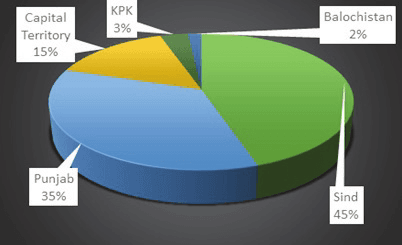
There are various attributes of this taxation system. More than 75 percent of the FBR collection comes from two provinces: Sindh and Punjab. Within Sindh and Punjab, two cities (Karachi and Lahore) contribute most to the national tax kitty. The province and capital territory wise breakup of collection is provided in figure 1.
Traditionally, the ratio-wise breakup between direct and indirect taxation has remained at 30:70, implying that there is a heavy reliance upon indirect taxation, which puts a bigger burden of taxation upon the middle and poor classes. The expected breakup of the tax revenue in this fiscal is given in figure 2.2
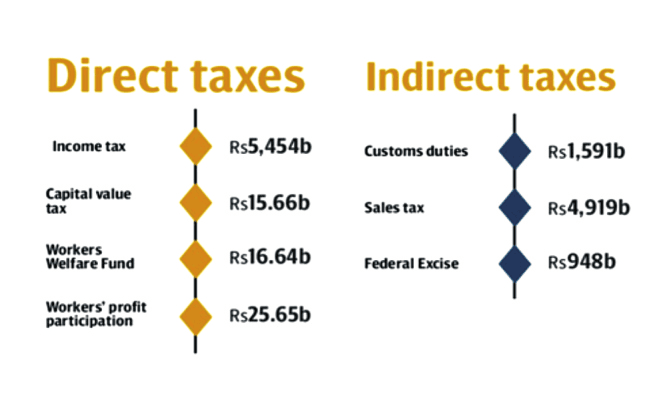
Figure 2: Breakdown of Direct and Indirect Taxes
The fiscal straits have elicited two different responses: at the citizens’ level, there have been continuous calls for reduction in runaway expenses (especially, the non-development, ‘current’ expenses), but on the government’s side, there has been consistent pressure upon the federal tax machinery to come up with more revenue! It is here that we find the entry/imprint of donors and their loans for Pakistan over the years, aimed mainly at addressing the inherent deficiencies in the working of the tax machinery. These range from a lack of application of technology in collection/mapping process, human capital quality to a limited pool of ‘filers’ (those who file their annual income and wealth returns every year).
A brief history of the loans availed by Pakistan by two leading donors, Asian Development Bank (ADB) and World Bank (WB) for enhancing its working and productivity is provided in the following table (in reverse order).3
| Donor Agency | Project Name | Date Approved | Status | Modality of Assistance | Amount (USD) | Amount (USD million) |
|---|---|---|---|---|---|---|
| ADB | 56006-001-Improved Resource Mobilization and Utilization Reform Program, Subprogram 1 | 4-Dec-23 | Approved | Loan | 300,000,000 | 300.0 |
| ADB | 56006-002-Preparing the Improved Domestic Resource Mobilization Reform Program | 4-Aug-22 | Active | Technical Assistance | 950,000 | 1.0 |
| ADB | TA 6662-PAK-Supporting Public Financial Management and Tax Policy | Dec-20 | Active | Technical Assistance | 550,000 | 0.6 |
| ADB | 53247-001-Economic Stabilization Program | 6-Dec-19 | Closed | Loan | 1,000,000,000 | 1,000.0 |
| ADB | 37213-013-Second Balochistan Resource Management Program – Subprogram 1 | 11-Dec-08 | Closed | Technical Assistance/ loan | 900,000,000 | 900.0 |
| ADB | 37213-012-Second Balochistan Resource Management Program | 12-Dec-07 | Closed | Technical Assistance | 400,000 | 0.4 |
| ADB | 41666-013-Punjab Government Efficiency Improvement Program (Subprogram 1) | 10-Dec-07 | Closed | Technical Assistance/ loan | 259,000,000 | 259.0 |
| ADB | 37135-013-Balochistan Resource Management (Program Loan) | 25-Nov-04 | Closed | Grant/Loan/ Technical Assistance | 135,320,000 | 135.3 |
| ADB | 36057-012-Enhancing Capacity for Resource Management & Institutional Reforms in Punjab | 5-Dec-02 | Closed | Technical Assistance | 680,000 | 0.7 |
| ADB | 36057-013-Punjab Resource Management Program | 4-Dec-03 | Closed | Loan | 204,000,000 | 204.0 |
| ADB | 37135-012-Balochistan Resource Management | 28-Nov-03 | Closed | Technical Assistance | 865,000 | 0.9 |
| ADB | 22231-Institutional Development of the National Tariff Commission | 4-Sep-89 | Closed | Technical Assistance | 475,000,000 | 475.0 |
| WB | P165982-Pakistan Raises Revenue | 2019 | Active | Loan | 400,000,000 | 400.0 |
| WB | P161463-Strengthening Tax Systems and Building Tax Policy Analysis Capacity | 2017 | Closed | Loan | 4,900,000 | 4.9 |
| WB | P132234-Punjab Public Management Reform Program | 2014 | Closed | Loan | 50,000,000 | 50.0 |
| WB | P077306-Pakistan Tax Administration Reforms Project | 2004 | Closed | Loan | 102,900,000 | 102.9 |
The latest in line of these loans by the WB, as indicated in the figure above, is the Pakistan Raises Revenue (PRR) loan, amounting to $400 million in total.
Basic Details of the Loan
The title of the project, for which the $400 million loan was approved, is ‘Pakistan Raises Revenue’ (PRR, P165982). The original development objective of the loan was approved on 12th June 2019, which stated that the loan was aimed to
“Contribute to a sustainable increase in domestic revenue by broadening the tax base and facilitating compliance”
There are two major components of this loan: The first is the ‘results-based component’ while the second is the ‘traditional IPF component’. A sum of $320 million was earmarked for the former, while the remaining $80 million was kept for the latter objective.
The first component includes four objectives areas:
- Simple & transparent tax system,
- Control of taxpayer obligations,
- Compliance facilitation,
- Institutional development
In contrast to the wider scope of objectives above, the second component is centered on upgrading FBRs Information Technology (ICT) systems.
What Does the World Bank Evaluation Say?
The most recent evaluation report by the WB gives an overall ‘satisfactory’ rating to the progress being made in terms of envisaged goals.4 It found that there is improved performance in terms of several Disbursement Linked Indicators (DLIs). The ranking of the WB team was based upon improvements it noticed in-
- publication of detailed tax expenditure and evidence-based revenue forecast report;
- functional data sharing with all provincial tax authorities (DLI 3);
- completion of 113 comprehensive field audits of large taxpayers and 784 issue-oriented audits (DLI 6) which meant that FBR surpassed its target for risk-based audits;
- a single returns portal was piloted for GST and GSTS, in unison with provincial authorities, covering the telecom sector (DLI 7);
- compared to 65% goods declared through red and yellow channels in FY19, the same number stood at to 29% in FY24 (DLI 8), reflecting improved customs efficiency in terms of reduced physical inspections at border;
- elimination and replacement of previously paper-based processes with newly automated internal business processes (DLI 9); and
- the continued tracking of Key Performance Indicators and publication of the annual results report for FY23 and a bi-annual report for FY24, as per DLI 1.
The only two indicators where it showed non-satisfaction were DLI 1 (reduction in WHT lines) and DLI 4 (implementation of track and trace system).
The said report also contains a tabular presentation of the espoused targets and the actual outcomes till now.5 A summary of the findings is presented below:
| Indicator | Outcome |
|---|---|
| FBR collection as percentage of GDP | Tax to GDP ratio was 10% in FY22, 9% in FY23, and –% in FY24. FBR collection was up from Rs. 6.1 trillion during FY22 to Rs. 7.1 trillion in FY23 and Rs. 9.2 trillion by end fiscal FY24.6 Tax to GDP ratio was affected by economic slow-down |
| Number of compliant tax payers | In FY 22-23, the number of registered income taxpayers increased from 7,969,014 to 9,865,335, an increase of approximately 24%. Within this, the number of ‘active’ taxpayers was 4,434,588, while 2,324,622 paid the tax with returns (‘filers’) |
| Hours to prepare, file and pay taxes (Hours) | The firm TORs are being prepared to conduct survey to assess performance against this indicator |
| Efficiency in custom clearance of key exports and imports (Percentage) | The firm TORs are being prepared to conduct survey to assess performance against this indicator |
| Simplified regulations for tax administration | The baseline for this indicator was that tax laws did not incorporate later amendments and had different provisions for tax administration. Plus, Customs Act not fully in line with international agreements. By time of this report, tax laws had been updated to include all subsequent amendments; there was unified tax administration provisions for all tax instruments; and Customs Act was fully aligned with Kyoto and TIR Conventions. Pre-arrival/pre-clearance system was introduced in FY21, and e-TIR module is being developed. A draft for a single IRS Code has been developed, but not yet approved |
| Automated sharing of taxpayer data (number of entities sharing data with the FBR) | Data sharing between FBR and 84 entities is continuing. These include 44 government departments, 11 electricity distribution companies and 29 Banks (Tax payer data is shared with other departments in order to lessen the incidence of tax theft, bring non-filers into tax net and to penalize those guilty of not following the tax law. Apparently this data sharing has had little impact upon widening the tax payer base or of lessening the reliance upon indirect taxes). |
| Systematic tracking of arrears | No regular monitoring and reporting system on tax arrears in place. Tax arrears tracked through Management Information System, collectability analyzed, and at least 40% of collectable arrears are resolved. Consolidated arrears data is not yet available. FBR has piloted electronic demand register for arrear management in Large Taxpayers’ Office, Karachi. FBR’s IT team is developing a comprehensive arrears management system, which is expected to be launched before December 2024 |
| Effective risk management in Customs (% inspections & audits that detect material violations) | On average, the material violations detected from custom inspections and audits decreased from 8% in FY21 and FY22, to 7% in FY23, and increased in FY24 to 11%. This is based on data on GDs inspections and Post-Clearance Audits (PCA), showing increase in number of GDs (about 197%) and relevant contraventions (around 400%). A consulting firm has been hired for the consolidation of frameworks for Central Risk Management System (CRMS) and PCA through comprehensive BPM/BPR of core business processes. Firm’s work is in progress |
| E-services for taxpayers and traders | Filing by mobile phone and online payments; taxpayers able to review their records online; taxpayers able to offset liabilities against receivables across taxes and fiscal years. Taxpayers are able to check their profile and status of tax transactions, liabilities, and refunds online in IRIS system. New Simplified Income Tax Return (ITR) for salaried individuals has been introduced. They can also file ITR through Tax Asaan App. Taxpayers are able to pay various types of taxes and arrears online (using ATM and e-banking facilities). However, the facility for taxpayers to offset liabilities against receivables (i.e. refunds due) from previous fiscal years and across tax instruments is not yet available. |
| Resolution of refunds (% of refunds claims resolved within 90 days) | FBR has completed mapping, redesign, and automation of refund system. Request for refunds can be made online in IRIS system, and related payments are transferred into taxpayer’s account directly. This will have positive effect in improving performance on this indicator. As per the information shared by FBR, during FY23 about 88% of rebates have been cleared by Customs within 90 Days, 75% of sales tax refunds were processed during the same period, and 92% of income tax claims were processed in 90 days (average of above taxes: 85%). In case of customs green channel, it takes about 1-2 days on average, to process a refund. For sales tax, FASTER refund system is launched to support timely refunds |
| Authorized Economic Operator (AEO) program (# of firms accredited) | AEO is a voluntary program. 3 Firms have been accredited under a pilot project (Artistic Denim Mills; Artistic Milliners PVT Ltd, and SLC Metals PVT Ltd). Legal coverage has been provided to AEO program (Section 212 A has been inserted in the Customs Act 1969). The rules of AEO program (notified vide SRO 798(1)/2020; SRO 1114(1)/2020, dated 26/10/2020; and SRO 263(1)2021, dated 23/02/2021) are being reviewed, to make it possible for more firms to be registered in the program to receive accreditation |
| Technical streams and specialized functions established | Specialized non-core functions established; trainings for core and non-core functions designed and delivered to at least 30% of grade 17 FBR officers. Comment on target: The technical streams have not been established in FBR. However, FBR officers are assigned to different positions relevant to technical/core and non-core functions, such as procurement, internal audit, communications etc. To design/re-design training for core and non-core functions, a need-based training plan is being developed by FBR |
| Timely transfer tax receipts and reconciliation of accounts in the TSA | Banks transfer tax receipts to the TSA at the end of each business day and reconciliation of accounts takes place monthly. Comment-Designated banks (NBP/commercial banks) transfer government revenue to treasury through SBP on daily basis, although some delays may occur. Revenue accounts reconciliation (collection and transfers) between FBR and treasury is done on monthly basis, although some variations are reported (e.g. due to impending refunds and delayed transfer by NBP). But there is no evidence of reconciliation of the assessments and arrears |
| Women’s representation among FBR staff | The overall percentage of women staff in FBR has increased from 6.8% (1,312 out of total 19,256 working strength) in June 2023 to 7.1% in May 2024 (1352 out of total working strength of 18,793). FBR is working on its plan to increase female participation in workforce, including lower grades where their participation is low |
| Obsolete ICT equipment | Legacy branded software updated, and active-active private cloud established. Procurement is underway for hardware and software, to be completed in FY25 |
| Provision of Data Warehouse | Big data capacity and Business Intelligence tools are functional. Procurement is underway for data warehouse hardware and software, to be completed in FY25 |
| FBR offices with full, permanent and reliable connectivity | FBR has confirmed that all of its offices have full connectivity. Reports from PRAL to confirm this are yet to be provided |
| Customs border stations with Automated Entry-Exit System | Procurement is underway for AEES related hardware and software, to be delivered by December 2024 / January 2025. Some components of Automatic Entry & Exit System (AEES) are being introduced including: Pre-Arrival Clearance system is deployed in WeBOC. Under this setting Terminal Operators (TOs) are getting electronic messaging regarding the release of cargo before arrival of the vessel. In collaboration with the collectorate of Customs Appraisement (East) and South Asia Pacific Terminal (SAPT), a pilot run of Automated Exit has been conducted. The collectorates are liaising with TOs to make necessary adjustments in their business processes, hardware and software to put in place the requisite system for fully functional AEES |
| Scope of withholding regime reduced (number of withholding lines). Reducing WHT agents by 50% in 4 sectors | |
| Transparent tax system | MoF (with input from FBR) has published in the ABS detailed tax expenditure and evidence-based revenue forecasts. FBR published updated tax gap estimates disaggregated by tax instrument |
| Coordination with provinces | FBR has signed MOUs /agreements with all four provinces on data-sharing with provincial tax authorities, immoveable property valuation tables, and on methods for GST input adjustments. FBR has harmonized the definitions of all economic activities subject to GST/GSTS with all 4 provinces |
| Track & Trace and electronic monitoring of production in key sectors (# of sectors) | At least 20% increase in collection of taxes from two sectors using electronic production monitoring system |
| New taxpayers identified through automated data sharing and ICT based business intelligence |
A Neutral Appraisal of the Loan
Although the WB analysis details the various aspects of the loans and the progress made upon the agreed-upon actions in the loan, there is a need for a third-party interest in order to bring a neutral view to the fore given the fact that the information provided to the donors (or even by the donors) may not be an exact reflection of the on-ground realities. This research effort does exactly that, and its findings upon the developments so far are provided in the table below.7
| Indicator | Outcome |
|---|---|
| FBR collection as percentage of GDP | Tax to GDP ratio from FY22 to end FY24 failed to show any significant improvement. COVID-19 Pandemic does not account for the poor showing of the FBR. After the pandemic, for example, GDP growth rate reached almost 6 percent in FY 22, yet the tax-to-GDP ratio remained the same. Moreover, although the aggregate collection showed significant improvement, a bifurcation of collection by numbers showed some worrying trends. There is still heavy reliance on import taxes, constituting 34 percent of collection by end FY24. There are indications that held-up amounts (refunds) are still being shown as part of collections |
| Number of compliant tax payers | We witness a pronounced failure on many fronts in this regard. As per FBRs statistics, reported in the media8, the number of income tax filers dropped by 35 percent compared to the previous year. Collection through direct tax (income tax) showed a significant rise by end FY24, touching 49 percent of total tax collection, but this happened not due to an expanded tax base but through increasing taxes significantly upon the filers/existing tax base. This is akin to penalizing the honest taxpayers, further squeezing their earnings, but also a boon for non-filers who still remain outside the ambit of FBRs reach. Similarly, the aim of bringing the millions of non-compliant retailers into the tax net through the ‘Tajir Dost’ scheme have failed so far. As of 30th June 2024, out of approximately 3 million retailers across the country, only 270,000 filed their income and wealth returns for the fiscal year FY 23-24, paying only Rs34 billion. As of 31st August 2024, only 277 retailers have paid a paltry Rs503,632 under this scheme. The number of ‘zero’ filers and ‘junk’ filers have jumped significantly, which has compelled FBR to move towards outsourcing audits of high net worth individuals |
| Hours to prepare, file and pay taxes (Hours) | Independent tax consultants and various tax researchers reported that in reality, tax compliance timings and costs have increased. One tax firm reported that on average, compliance cost has now reached Rs.250,000 irrespective of size of the business. Business are now increasingly resorting to go on a ‘double book keeping’ mode to avert increased taxation rates and compliance costs |
| Efficiency in custom clearance of key exports and imports | There has been noted improvement in clearance times, but many challenges still remain, specifically on procedural and administrative side. This is demonstrated well by the recent incident of non-clearance of specialized mountaineering boots of Miss Samar Khan, a noted Pakistani female climber by the Customs. Only after the intervention of higher officials, after this lapse appeared in the media and she herself posted it on X, did the shoes get released, after 1 month |
| Simplified regulations for tax administration | Although the language and modalities of relevant acts (like Customs Act) has been updated, but the update has not resulted in any marked improvement in the workings of the customs department or any other arm of the FBR. For example, legal complications (like the role of Tribunals) is still a point of contention, with their average decision time still pretty much the same as the before. Similarly, the application of pre-arrival/pre-clearance system was introduced in FY21 has not led to any marked productivity. The e-TIR module still remains undeveloped, while similar is the case with draft for a single IRS Code has been developed, but not yet approved (?) |
| Automated sharing of taxpayer data (number of entities sharing data with the FBR) | Tax payer or tax related data is normally shared with other departments in order to lessen the incidence of tax theft, bring non-filers into tax net and to penalize those guilty of not following the tax law. Other than that, FBRs own document puts the data sharing to facilitation of supply chain operators for electronic data invoice sharing.9 In fact, one can find specific portal dedicated to data sharing on FBRs website. However, apparently this data sharing has had little impact upon widening the tax payer base or of lessening the reliance upon indirect taxes |
| Systematic tracking of arrears | Ground realities are different than claimed by the report. Trillions of rupees are still in courts/litigation, and there is no public information upon the kinds of arrears, how they are defined and its quantum. It’s a closely guarded secret |
| Effective risk management in Customs (% inspections & audits that detect material violations) | Although a consulting firm has indeed been hired for the consolidation of frameworks for Central Risk Management System (CRMS) and PCA, the work is likely going to take longer than initially assumed. Systemic hurdles (legal, administrative) are slowing down the process, and material violations are still common. In essence, the issues plaguing Customs violations arise as part of overall economic environment, when the chances (and opportunities) for smuggling and black market activities increase. Recently, a third party audit was ordered of all FBR projects |
| E-services for taxpayers and traders | There is indeed greater ease in terms of filing taxes through various electronic means. However, the claim that New Simplified Income Tax Return (ITR) for salaried individuals is a simpler format has been disputed by majority outside of FBR. Also, use of ATM and e-banking facilities are active, but often runs into a non-responsive FBR portal. When it comes to due refunds, these still pose a major hindrance as majority of the claimants have yet to be issued refunds. Recently, an incident came to light whereby the release of valid refunds (validated through all sources) led to suspension of two senior FBR officers, sending a negative message within FBR employees in terms of issuing refunds |
| Resolution of refunds (% of refunds claims resolved within 90 days) | Totally false to claim that issues related to refunds have been resolved, or that a system of validating and issuing refunds within 90 days is in place. As demonstrated above, FBR is still refusing to release refunds. There is neither a clear strategy nor the will from the government to settle this issue for good |
| Authorized Economic Operator (AEO) program (# of firms accredited) | AEO is part of the proposed ‘Asan Karobar’ bill of the federal government that intends to lessen the burden of regulations for businesses across the country. On 23rd March 2024, the Prime Minister of Pakistan formed a Committee on Ease of Doing Business (CoEDB) for application of Asan Karobar and other related steps. However, as a recent PIDE analysis concludes, the contours of the bill, the detailed workings under the bill, criterions, etc., are non-transparent or unclear, and it is likely to increase bureaucratic hold upon this subject (if implemented)10 |
| Technical streams and specialized functions established | It is not as if FBR did not have bi-furcation by core functions before the loan! Majority of experts and FBR people spoken to in this regard this step as nothing more than optics since it is highly unlikely to lead to any efficiency gains or bring about any major productivity improvements. Recently, PRAL Board was reconstituted and 5 groups were formed within FBR for revamping its structure |
| Timely transfer tax receipts and reconciliation of accounts in the TSA | Financial management is much better than before as federal government moves towards full implementation of TSA, but there is still no evidence of reconciliation of the assessments and arrears, neither is there a completely settled mechanism between the banks and FBR. The application of TSA still remains incomplete. As per the sources in the Finance Division, more than 80 thousand accounts of the federal government alone still remain outside the ambit of TSA. Consolidating all non-government accounts still poses a significant challenge |
| Women’s representation among FBR staff | The overall percentage of women staff in FBR still remains low. More importantly, in context of improving the tax machinery’s efficiency, which remains the main concern of the donors and the government, it is not clear how increased female labor force within FBR would help achieving this goal? |
| Obsolete ICT equipment | New hardware and software has been purchased and distributed amongst FBRs field formations and personnel, although not even half of amount for purchases has been utilized |
| Provision of Data Warehouse | The establishment of a Data Warehouse still remains behind schedule |
| FBR offices with full, permanent and reliable connectivity | All FBR offices across the country have full connectivity. However, the level and quality of connectivity differ substantially in lieu of frequent internet disruptions and setting up of an internet firewall by the government. Outside of main urban centers, connectivity quality remains moderate to poor |
| Customs border stations with Automated Entry-Exit System | The implementation is in process. However, given the security situation on most border trade terminals of Pakistan and the related administrative issues, majority of individuals spoken to doubt whether the setting up and implementation of the software and hardware systems on border terminals would lead to major revenue gains since the border trade, especially with Afghanistan, has seen a precipitous decline |
| Scope of withholding regime reduced (number of withholding lines). Reducing WHT agents by 50% in 4 sectors | No significant improvement with regards to lessening WHT lines. Some lines abolished in 2023-24 budget, but many new lines introduced in the present budget (Budget 24-25) to meet higher revenue targets |
| Transparent tax system | On track in terms of publications (partially, as tax directory of Parliamentarians has been withdrawn), but transparency regarding decision-making within FBR, interaction with other departments, postings and transfers, etc., still remains non-transparent |
| Coordination with provinces | The coordination continues, but there is still a lot of work to be done. Legal and administrative issues remain in relations between tax machineries at federal and provincial levels. Property valuation rates have been revised several times to bring them at par with market rates, but it is still around 50-60 percent of market values. But this has not stopped provision of subsidized land provision to civil servants, armed forces and judiciary at very low rates compared to the market. Moreover, there is no tax upon retired and serving civil servants, military and judges to pay the new tax rates upon sale of their properties |
| Track & Trace and electronic monitoring of production in key sectors (# of sectors) | The implementation of a Track & Trace system has been in the works since early 2021 and was supposed to be completed by February 2022. However, the implementation is still incomplete. Unfortunately, it has been plagued by administrative and transparency issues. A recent inquiry into T&Ts Rs. 25 billion contract award found two former Chairmen and a Project Director guilty.11 It took 2 long years to decide the vendor in the first place, but the contract was declared null and void by Islamabad High Court (IHC) on grounds of corrupt practices. The second awarded contract was also challenged, and is still in the Supreme Court for decision. There were questionable actions, like setting aside WB criteria for hiring an independent consultant to choose a vendor. The produced stamps for affixing upon products have been found to be faulty, and required internet services for effective T&T system are not available around the clock in most areas of the country |
| New taxpayers identified through automated data sharing and ICT based business intelligence | FBR has extensive data of those individuals (high net worth and a bit lower) that do not file tax returns and evade their due taxes. This data comes from various sources. For example, under former Chairman Tariq Malik, NADRA provided the requisite data using sophisticated AI techniques. However, implementation remains non-existent! In fact, as shown above, the number of active taxpayers has decreased. Additionally, and surprisingly, FBR recently signed agreement with international consulting firm, McKinsey, to help identify non-compliant taxpayers, a task already accomplished as FBR has the data |
The Views from FBR and WB: Contrasts and Unanimity
What the above stated analysis depicts is that substantial issues remain in terms of workings of the FBR, plaguing its overall efficiency and administrative as well as technical affairs. The way things stand, it is highly likely that this loan will go the TARP way: achieving little (if anything) and saddling the government with even more liabilities!
But why this state of affairs? Was not anything learned from earlier mistakes in order to ensure that past mistakes are not repeated, and that this loan helps FBR become an efficient, productive and meaningful organization? We get probable answers to this query in the form of responses of FBR and WB officials to the questions posed to them for the purpose of this report.12 The responses bring out the contrasts as well as agreements on both sides. These are documented in the table below, bifurcated by topics.13
The necessity of the loan
There is no case of the WB offering loans by itself: All loans are requested by the government, which requests support (financial and technical). The FBR official affirmed that the letter did go from the FBR for this loan, but also conveyed that the loan was pushed upon the FBR. The official declined to name the agency or person who pushed this upon them, but conveyed that the reason for telling this is that the FBR is needlessly blamed for everything without knowing the ground realities. The implication is that utilizing the loan was a post-loan agreement exercise (rather than doing the homework before), a stance that the FBR official acknowledged.
Progress upon the main goals
There are two major components of this loan: The first is the ‘Results-based component’ while the second is the ‘Traditional IPF component.’ How satisfied is the WB and FBR with progress on these? The view from FBR is that 40 percent of the envisaged goals under this loan have been achieved, at max. The other side also acknowledged that there were many pressing issues still, but did not give any specific percentage. Pakistan has not achieved the main goal, i.e., higher tax-to-GDP ratio. It’s not so much about achieving objective, but about the context and overall atmosphere, like exemptions, which are unwarranted. It’s not satisfactory, but there were certain positive developments. We need to build upon these positives and look at the broader context. Component 2, however, has significant problems.
Progress upon sub-goals of first component
The first component includes four objectives areas: Simple & transparent tax system, Control of taxpayer obligations, Compliance facilitation, and Institutional development. What has been the overall progress on these? FBR official maintained what he said before, that 40 percent of the envisaged goals were achieved, even if looking at these areas individually. But there was no equal progress. For example, in terms of transparency, the FBR had to withdraw publishing Parliamentarians’ Tax Directory, which puts a question mark on the transparency claim. On transparency, when the FBR official was asked whether armed forces personnel (serving and retired) and Bureaucrats file their returns, he refused to comment. When asked whether all FBR officials file their returns, the official confessed that they did try, but the resistance this move faced from within was astonishing. People cannot imagine the pressure they were put under (there were like 20 calls, on average, per day from very influential people in the halls of power to let go off of this idea). FBRs top management pleaded that they could not ask people to be filers when we don’t do it ourselves. Unfortunately, it fell on deaf ears. There was refusal to comment upon the question of who called/pressured FBR and what was the present percentage of FBR employees filing their tax returns?
The WB official took a more positive view in this regard, contending that business process re-engineering has been completed, which was a substantial achievement. Identification of new taxpayers, audits based on algorithms, etc., were the goals we achieved. Customs efficiency and clearance is another area that has seen considerable progress. But for others, there are still challenges.
Towards ‘paperless’ transactions
The most recent report by the WB gives ‘satisfactory’ rating to this loan. One of its contentions is that there has been significant improvement in lessening paper-based transactions, moving towards ‘automated internal business processes.’ What were some of the examples of these? How has it helped widen tax net or made it easy for customers? Any quantified estimate of improvement? Government official could not provide a quantified estimate of improvements, but said that there had been some. A good portion of FBR regional offices are now increasingly using electronic means to do their work. Paperless transactions are increasing but it will take time. FBR official stated that a lot of things were not in their control, like the political pressure and the overall numbers of electronic transactions within the country. Regarding tax net widening, he said it had not made any substantial impact, at least till now, but there is a good chance of improvements in coming days.
The WB official also could not provide specific examples, contending that main idea was to reduce the capacity burden upon FBR to free them to focus upon increasing higher tax to GDP ratios. But again, a lot of things have to work in unison for it to have impact.
The aim to widen the tax net
One of the main aims of the loan was to widen the tax net, which till now has shown little or no improvement since the loan was contracted back in 2019. The WB representative acknowledged that this aim indeed remained unfulfilled, but the fault lies mainly at the government’s end, especially the political favors doled out in the form of exemptions and subsidies. Also, there were still many issues plaguing the working of the FBR that hindered its transformation towards an efficient tax collection agency. The FBR official’s view was similar to the position taken by the WB.
But there is an interesting aspect to this issue. The FBR recently hired global consultancy firm, McKinsey, in order to help it widen the tax net. But was the same not to be done under PRR? What were the things not covered under PRR that led to hiring McKinsey? The FBR official was very forthcoming in his response: some things are beyond their powers. If there is an order from above, what can they do except to follow it? The official did not reply when asked whether, as per news reports, it was SIFC that made the push for hiring McKinsey? It was the official’s personal view that there really was no need for hiring McKinsey as FBR and government departments already had the data. Some time back, NADRA gave FBR comprehensive data on non-payers and taxable assets/income. It’s all about implementing plans, and there FBR has its limitations.
Why the need for additional financial resources?
Closely tied to the above is the recent case of FBR requesting an additional Rs. 34 billion from the federal government for systemic upgrades. This came as a surprise since the PRR loan has not been utilized, so why not utilize that amount first? This question was only put to the FBR official. The contention was that The WB loan comes with its directions for use and FBR cannot utilize it on matters outside loans ambit. So we may need separate resources, which is why FBR asked government for the additional amount. On the question of what are the additional resources for? Could the official be specific in terms of areas that are different than one covered by WB loan? This query was not answered.
Reasons for low tax-to-GDP ratio
The poor or stagnant tax-to-GDP ratio over the course of the loan is blamed upon COVID-19. But is that a good/reliable explanation? GDP growth bounced back after that, with one fiscal year seeing GDP growth up to 6 percent. Yet the tax-to-GDP ratio hardly budged, including the composition of tax collection (direct and indirect). Does it not constitute a failure? FBR official acknowledged that it definitely is a failure in the sense that the tax-to-GDP ratio is still very poor, and that COVID-19 should not be an excuse for our poor performance. But in their defense, their hands are tied. And it is not just the political pressures. Take the example of courts; they have undeniable proof of many individuals and organizations not paying their due taxes. But as soon as they send them a notice (FBR cannot proceed against them without first sending a notice), they get a stay order from courts, which then keeps dragging on.14
For the WB official, tax policy and tax administration has huge problems. It is impossible to fix issues of the tax system with just one project, like this one. If we look at the FBR tax report and its exemptions, it becomes very challenging to move ahead with the objectives envisaged in these kinds of loans and projects. If there had been no exemptions, as the project envisaged, tax to GDP ratio would have been around 12.5 to 13 percent. So, perhaps a lesson for the project is that WB should have been more focused upon exemptions and stopping future ones. But that did not happen.
The ‘Tajir Dost’ scheme
The terms of expanding the tax base, what were the views on ‘Tajir Dost’ scheme for bringing in retailers in the tax net? ‘Tajir Dost’ scheme has failed so far. As of 30th June 2024, out of approximately 3 million retailers across the country, only 270,000 filed their income and wealth returns for the fiscal year FY 23-24, paying only Rs34 billion. As of 31st August 2024, only 277 retailers had paid only Rs503,632 under this scheme. The WB official said that this scheme was not covered under the PRR loan. As for the FBR official, there was acknowledgement of its failure. But there was again the stance that the fault did not lie at their end and the question needs to be put to the political leadership. FBR has the data, they have the number but are not allowed to do their work and proceed against non-filers.
The number of ‘active’ filers and zero return filers
In terms of expanding the tax base, the absolute number of ‘active’ filers has been reported to have declined, meaning an even smaller base for paying taxes on wealth. An increasing number is returning ‘zero income’ status. Why does the situation remain precarious in terms of attracting more willing filers? For FBR official, it is basically a systemic weakness, especially weak audit and reporting system. If what had been envisaged under PRR had been implemented, the zero returns issue would have been ameliorated to a large extent. Unfortunately, for various reasons, it could not be done, although they are pushing it ahead. In general, though, the personal view was that people will keep finding ways to evade returns till they can be convinced that no one is exempt from paying taxes. This will have to be complemented by a robust court system where evaders are punished.
WB view was that there had been a sharp increase in filers, 1.5 million through this project. But what is filed is an issue. But FBR now has a base and we can go on from here. WB cannot help with that; they can only provide support and advice. Rest is up to government of Pakistan. The FBR cannot do anything if exemptions are continually being granted despite WBs advice. The overall tax system needs a makeover, and they can help with incremental changes.
Outcome of information sharing between provinces and federal government
Has the information sharing arrangements between the federal government and the provincial governments led to any improvement in expanding tax base and more efficient tax systems? For the WB official, this arrangement is what helped identify a lot of new taxpayers and filers. It is one of the aspects of the project that has worked pretty well. FBRs official contended that by now, there were good data sharing arrangements between the federal and provincial governments. It was working well, though there is always room for improvement. Take the example of KP government’s substantial increase in revenue that became possible due to data sharing.
Arrears and Refunds
Arrears and refunds still remain a major issue at the FBR. Trillions are still stuck in court cases. Recently, two FBR officials were suspended for issuing a long-held refund, after completion of all the due process. Why has it not improved? For the FBR official, there were many issues still plaguing the FBRs workings, reflected amply in this case. The officials that were suspended had followed every protocol for clearance of dues, including a request by higher ups to expedite that particular transaction. However, political expedience resulted in action against them. Just imagine what kind of message was being sent within FBR- damned if you do, damned if you don’t! The WB official contended that the WB does not have full visibility of workings of FBR, and that they are limited in their scope and influence.
The ‘Asan Karobar’ framework
One of the components of the intended use of loan was the Authorized Economic Operator (AEO), which led to the ‘Asan Karobar’ bill in March 2024. Will it work? For the WB official, it will ultimately come down to political commitment in this case. They are working closely with BOI on this, with $17 million technical assistance assigned to lessen regulations and make it easy for businesses. So, yes, this act establishes a framework. The FBR official took the same stance, stating that lessening regulations has been a pressing need for decades. No doubt we need it. So, this is a welcome step. However, its implementation, again, is more of a political rather than administrative or ability matter. When it was pointed out that a recent PIDE study actually cast doubt about many of its provisions, concluding that it will empower the bureaucracy more and increase the economic footprint of the government, the FBR official was not aware of the study.
Technical streams and specialized functions within FBR
The WB review claimed that ‘Technical streams and specialized functions established’ in FBR. But there is no details on what it means, and how it has helped FBR in its aims? Any examples? The FBR official took an opposite stance, saying that there has not been much development on this front, mainly because of silo mentalities whereby every sub-department within FBR acts as an independent entity, monopolizing the administrative procedures and work under their watch. Frequent changes in personnel and political appointees also complicate the matter.
WB official also acknowledged the difficulties. What they would have wanted did not quite work out, mainly because there had been persistent changes in Project Directors (PD). PDs require specialized training, for example, in procurement rules, but PDs being appointed in FBR don’t necessarily have that experience. There are other internal issues, like the tussle between IRIS and PCS, each trying to get more of the resources diverted to them. Only one meeting of the steering committee, headed by Finance Minister, had been held in 4 years (it has picked up now). The functional realignment that we perceived is not happening.
Progress on Treasury Single Account (TSA)
The WB review also talks about ‘reconciliation of accounts through Treasury Single Account or TSA. But as per the sources in the Finance Division, more than 80 thousand accounts of the federal government alone still remain outside the ambit of TSA. FBRs official was not aware much about this matter. It was basically a finance division related issue. FBR coordinates with them closely and whatever they receive from Finance is passed on to the WB. WB official posited that there were an estimated $50 million savings from fully implementing TSA. A lot of progress has been made but still a lot to do, like the non-automation of substantial number of NBP branches, especially the smaller branches, which still use manual procedures.
Has the new equipment helped?
New hardware and software have been purchased for the FBR and distributed amongst its locations around the country. How has that improved FBRs overall goals and uplift its human capital capacity? FBR official contended that whatever equipment we have bought, it has been of help, especially scanners. We really need those, especially on border crossings. With scanners, the country can easily improve the commerce and trade across borders manifold, thereby realizing substantial revenue potential. The WB has extended its full help in this regard. Unfortunately, the process of purchases has really been very slow at FBRs end, mainly due to administrative issues.
The WB official, however, was less sanguine about the outcomes. Of the $80 million allocated for this purpose, only $1.4 million has been spent, mainly on studies for upgrading the capacity of the FBR, like establishing new data centers and scanners across airports. There have been changes in direction and policies of the FBR, like the recent interaction with McKinsey on a ‘Transformation Plan.’ So, WB had no idea how FBR will proceed with using the remaining amount or buying the required equipment.
The issues at border terminals/trade points
Customs border stations with automated exit and entry still encounters significant issues, especially at the Pak-Afghan border. Is the issue at the FBR level or something else? I have already stated that there are issues at our end. But of course, there are other government entities that are part of this issue of non-implementation. Border points like Torkham have presence of many government entities in one place, and that creates a lot of issues, especially when security situation becomes adverse, which leads to border closure for days and months. The security related institutions have their own rules that can hinder the process. For example, they argue that quick clearance often leads to missing smuggled goods, which may include sensitive/banned equipment like weaponry. That is why the official advocated buying more scanners in order to ease these issues.
For WB, there were three parts of this. Some good progress on the scanners side, which is only one component. The other two have yet to be implemented. It is very slow. A lot of the issues come from the fact that every port has its own rules and procedures rather than one. The idea was that a firm will come in and find a common solution for them, but that has not happened, like a common system that could have customs scanned pictures that could be shared for comparison and tracking. There were issues in Risk Management System, as only 20 to 30 percent scanning is done, citing congestion at border crossings. But then this puts a question mark on automation because there’s not much advantage of automation if it’s only 20-30 percent.
The vexing issue of Track and Trace system
The implementation of a Track & Trace System has been in the works since early 2021 and was supposed to be completed by February 2022. However, the implementation is still incomplete. Unfortunately, it has been plagued by administrative and transparency issues. A recent inquiry into T&TS Rs. 25 billion contract award found two former Chairmen and a Project Director guilty. The courts have annulled later contracts for being corrupt. How did they view this?
For the FBR official, Track & Trace System served as a great example of why a well-designed, well-intentioned step fails? From the very start, it was handed over to individuals who were in FBR due to their political connections rather than skills and management abilities. Even when they tried to implement it honestly, the political leadership and courts have blocked our way, ensuring that the system does not work. There has again been a renewed seriousness at the top level. The official hoped this time it really translates into solid measures.
WB official contended that the FBR has been trying to implement it for the last 15 years but courts and court stays have been a huge problem. They were in the process of hiring a firm that will analyze the whole workings of this, they will work with the Customs to bring out solutions. IRIS and Customs should ideally be working together despite both of them working in FBR.
Conclusion
In the aftermath of the Pakistan Tax Administration and Reforms Proposal (TARP, 2004-2010), a $400 million loan, there were various assessments carried out. One of the best was by Musharraf Rasool Cyan and Jorge Martina Vasquez, which contained the following para:15
“…a great failure—on its conclusion not only did tax-to-GDP ratio fall substantially, there was a tremendous decrease in the number of return filers…prescription of the World Bank (WB) and International Monetary Fund (IMF) suggesting “more taxes” without growth, equity and delivery of social services to the citizens is a lethal pill, based on a diagnosis by a quack rather than by a qualified physician.”
The jury is still out on PRR, as the loan is still to be completely utilized, but there are worrisome indications that this loan may also go the way of the earlier TARP (with perhaps minor improvements). There seems to be many reasons to believe so, partly reflected in the information gathered during the impartial appraisal of this loan, and also in light of information coming out of the interviews conducted with FBR and WB officials. It occurs that both the creditors and the institution taking the loan (FBR as well as federal Government of Pakistan) refused to learn anything from the past episodes of failure, as well as taking ground realities into consideration.
The main objective of the loan, as stated in the document, was to ‘Contribute to a sustainable increase in domestic revenue by broadening the tax base and facilitating compliance.’
There were two major components of the loan, with the first component having four objectives areas:
- Simple & transparent tax system
- Control of taxpayer obligations
- Compliance facilitation
- Institutional development
Given the analysis, it can be easily gauged that till now, not only has the main objective not been achieved but the four main objectives of the first component also remained unfulfilled. With 80 percent of the loan already utilized, it is highly improbable that there can be any major improvements with the remaining utilization of loans. FBRs inner workings remain the same (which reflect failure to develop institution and its capacity), Tax-to-GDP ratio has hardly budged, the number of filers has gone down, efforts to bring in retailers and other non-compliant groups into the tax net have failed or have had negligible success, etc.
Similar is the case with the use of technology within the FBR, for which WBs loan has its second component, aimed at facilitating software and hardware provision. Solow’s famous 1987 quote that ‘you can see the computer age everywhere but in the productivity statistics’ would be an apt description of things stand! Equipping FBR with latest technology, IT equipment and complementarities is highly unlikely to enhance productivity substantially since the workings and management style remains the same. For example, the organization is still run by the bureaucracy (specifically PAS) and is beholden to group and political pressures. Moreover, political pressures still hamper the workings of this institution considerably.
All in all, up till now, PRR loan has failed to ameliorate the issues plaguing Pakistan’s tax system and tax machinery for long.
Bibliography
- “FBR faces rise in nil-filers as 68% of tax returns declare zero income.” Profit. September 24, 2024. https://profit.pakistantoday.com.pk/2024/09/24/fbr-faces-rise-in-nil-filers-as-68-of-tax-returns-declare-zero-income/
- Finance Division, Government of Pakistan. “Federal Budget 2024-25.” June 12, 2024. https://www.finance.gov.pk/budget/Budget_2024_25/Budget_in_Brief.pdf
- Haque, Nadeem Ul., Ahmed Waqar Qasim, Azwar Muhammad Aslam, Abbas Moosvi, Usman Qadir, Shahid Mahmood, and Mohammad Armughan. “PIDE Commentary: PMs Committee on Ease of Doing Business.” Pakistan Institute of Development Economics. 2024. https://pide.org.pk/research/pide-commentary-pms-committee-on-ease-of-doing-business/
- Khan, Mubarak Zeb. “Tajir Dost Fails to Boost Tax Compliance.” DAWN. August 29, 2024. https://www.dawn.com/news/1855386
- Khan, Mubarak Zeb. “Number of ‘junk tax’ returns surges to 2.7m in 2023.” DAWN. September 24, 2024. https://www.dawn.com/news/1860770
- Martinez-Vazquez, Jorge, and Musharraf Rasool Cyan. The Role of Taxation in Pakistan’s Revival. Oxford University Press, 2015.
- Press Information Department. “FBR comfortably achieves target for the FY 2023-24.” July 1, 2024. https://pid.gov.pk/site/press_detail/25734
- Rana, Shahbaz. “Income tax filers drop by 35%.” The Express Tribune. March 1, 2024. https://tribune.com.pk/story/2458030/income-tax-filers-drop-35
- Rana, Shahbaz. “Inquiry names FBR officials in Rs25b faulty T&T contract.” The Express Tribune. May 8, 2024. https://tribune.com.pk/story/2465608/inquiry-names-fbr-officials-in-rs25b-faulty-tt-contract
- Rana, Shahbaz. “Govt unleashes tax tsunami.” The Express Tribune. June 13, 2024. https://tribune.com.pk/story/2471369/govt-unleashes-tax-tsunami
- Rana, Shahbaz. “Officers suspended for valid refunds.” The Express Tribune. September 6, 2024. https://tribune.com.pk/story/2493887/officers-suspended-for-valid-refunds
- “Technical specification for data sharing through API with FBR.” Federal Board of Revenue. December 20, 2023. https://download1.fbr.gov.pk/Docs/202312202312256464Technical-Specification-Digital-Invoicing.pdf
Annexure-A: How Courts Intervene in Tax Collection
Billionaire Wilayat Khan and Associates Get Millions in Tax Relief on Rs 120 Million Decree.
The Federal Board of Revenue (FBR) has reportedly written off millions in taxes owed by billionaire Wilayat Khan, son of Sher Alam, along with his close associate. The tax relief comes on the heels of a decree passed by the Sessions Court in Mardan, favoring the affluent businessman and his companion, effectively exonerating them from a substantial financial obligation. The decree, amounting to Rs 120 million, has stirred significant unrest among the public, with critics accusing the authorities of bending rules for the ultra-wealthy. Wilayat Khan, known for his extensive business empire, was expected to bear the brunt of the tax regulations, yet the court’s decision seems to have paved the way for what some are calling a “tax pardon.” The case has reignited concerns over Pakistan’s tax policies and the unequal treatment of the rich and the powerful. Many are questioning the integrity of the system, fearing that such rulings may set a dangerous precedent for others seeking to evade financial responsibility through legal loopholes. Public outcry is growing as details emerge about how this decision was reached and what it means for the country’s efforts to collect taxes from the nation’s wealthiest citizens.
Source: Bureaucracy (@Bureaucracy3533), “FBR PESHAWAR / MARDAN FORGIVE MILLIONS OF TAX ON RS 120 MILLION DECREE PASSED BY SESSION JUDGE MARDAN IN FAVOR OF A BILLIONAIRE NAMED WILAYAT KHAN S/O SHER ALAM,” X, October 11, 2024, 8:24 a.m., twitter.com/Bureaucracy3533/status/1844584210725732426
Notes
- Finance Division, Government of Pakistan, “Federal Budget 2024-25,” June 12, 2024, https://www.finance.gov.pk/budget/Budget_2024_25/Budget_in_Brief.pdf
- Shahbaz Rana, “Govt unleashes tax tsunami,” The Express Tribune, June 13, 2024, https://tribune.com.pk/story/2471369/govt-unleashes-tax-tsunami
- Dr Mahmood Khalid, email message to author, August 2024.
- ‘Implementation Status and Results Report’, 9th August 2024
- p.3 onwards
- Press Information Department, “FBR comfortably achieves target for the FY 2023-24,” July 1, 2024, https://pid.gov.pk/site/press_detail/25734
- FBR officials, independent researchers and tax consultants were contacted for this independent evaluation and gathering information. All of them, however, requested anonymity
- Shahbaz Rana, “Income tax filers drop by 35%,” The Express Tribune, March 1, 2024, https://tribune.com.pk/story/2458030/income-tax-filers-drop-35
- “Technical specification for data sharing through API with FBR,” Federal Board of Revenue, December 20, 2023, https://download1.fbr.gov.pk/Docs/202312202312256464Technical-Specification-Digital-Invoicing.pdf
- Nadeem Ul Haque et al., “PIDE Commentary: PMs Committee on Ease of Doing Business.” Pakistan Institute of Development Economics. 2024. https://pide.org.pk/research/pide-commentary-pms-committee-on-ease-of-doing-business/
- Shahbaz Rana, “Inquiry names FBR officials in Rs25b faulty T&T contract.” The Express Tribune, May 8, 2024, https://tribune.com.pk/story/2465608/inquiry-names-fbr-officials-in-rs25b-faulty-tt-contract
- Their answers are produced here in a general format (in authors’ own words) rather than quotations. The FBR official chose to remain anonymous, fearing backlash given the prevailing environment. From WB, Mr. Tobias Haq (assisted briefly by Miss Ayesha) was interviewed on 22nd October at WB office, G-5/I, Islamabad
- The responses are stated in brief (without missing/altering the main message). Some questions were put to one party only, with the blank box indicative of that question not being put to the other party
- See Annexure-A, involving a recent case whereby court let a tax defaulter go free
- Jorge Martinez-Vazquez and Musharraf Rasool Cyan. The Role of Taxation in Pakistan’s Revival. Oxford University Press, 2015.